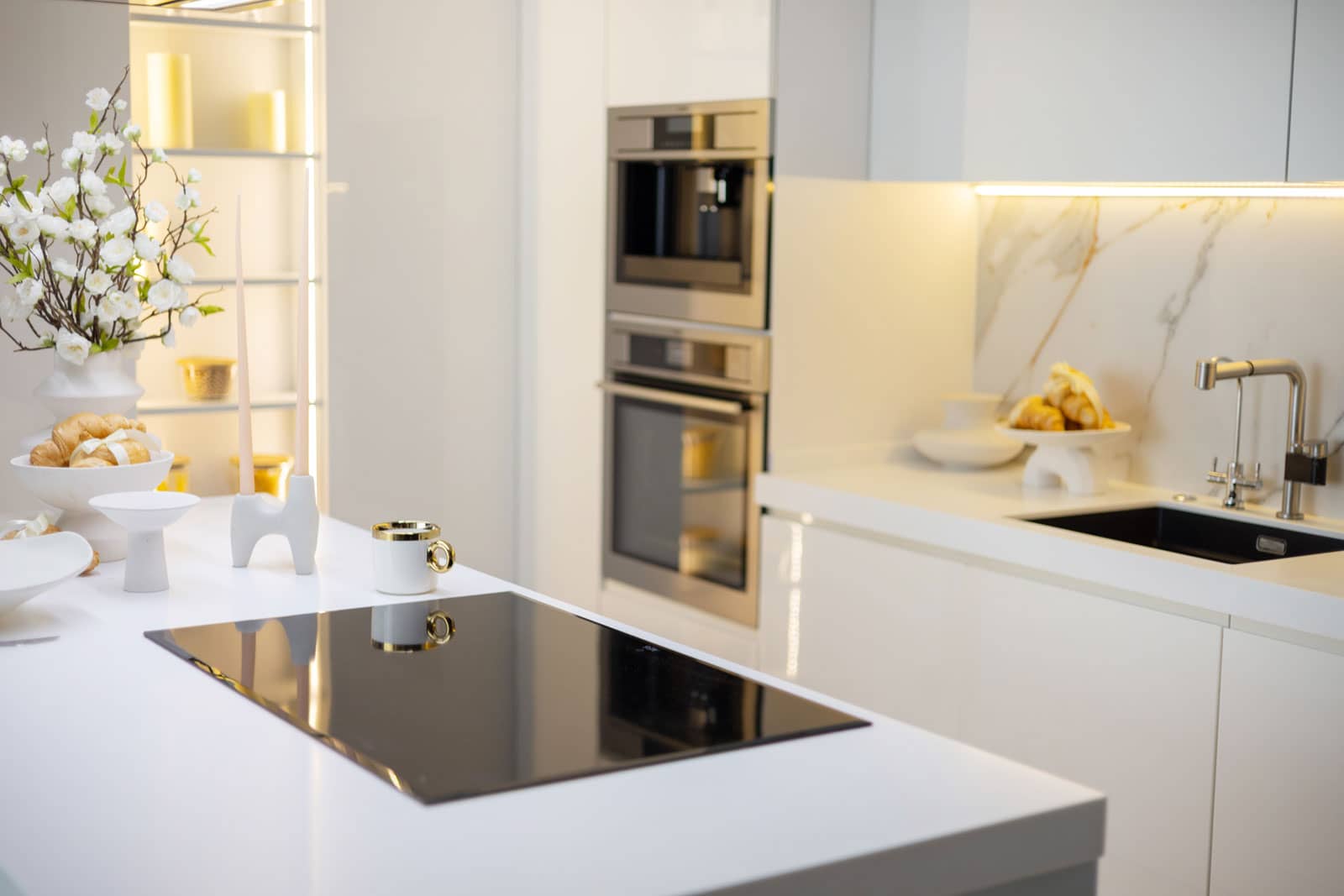
Quick answer: If your cabinet boxes are solid, you can change kitchen unit doors and drawer fronts without replacing the cabinets themselves. The 12 looks that update old cabinets best are classic Shaker, slim Shaker, matte slab, wood-grain slab, high-gloss slab, fluted, glass-front, beadboard, simplified raised panel, arched, cane-insert, and handleless doors. In Orange County, most door replacement projects cost $6,000 to $12,000 and install in one to three days.
Almost every week, a homeowner walks into our Tustin showroom holding a phone photo of their kitchen and asks the same question: “Do I really need new cabinets?” More often than people expect, the answer is no. The cabinet boxes in many Orange County homes built in the 1980s and 1990s were made to last. What ages badly is the part everyone sees: the doors.
Honey oak with cathedral arches. White thermofoil that has turned the color of weak tea beside the oven. Heavy raised panels with brass knobs that date the entire house. Swap those fronts, and the whole room changes.
That’s why so many homeowners decide to change kitchen unit doors instead of starting a full renovation. You keep the boxes, countertops, and plumbing exactly where they are, and you get a kitchen that looks current in days rather than weeks.
In this guide, our team walks you through 12 door styles that genuinely refresh old cabinets, the materials worth paying for, what the work costs in Orange County in 2026, and the installation details (hinges, overlays, lead paint, ventilation) that decide whether the finished job looks custom or cobbled together.
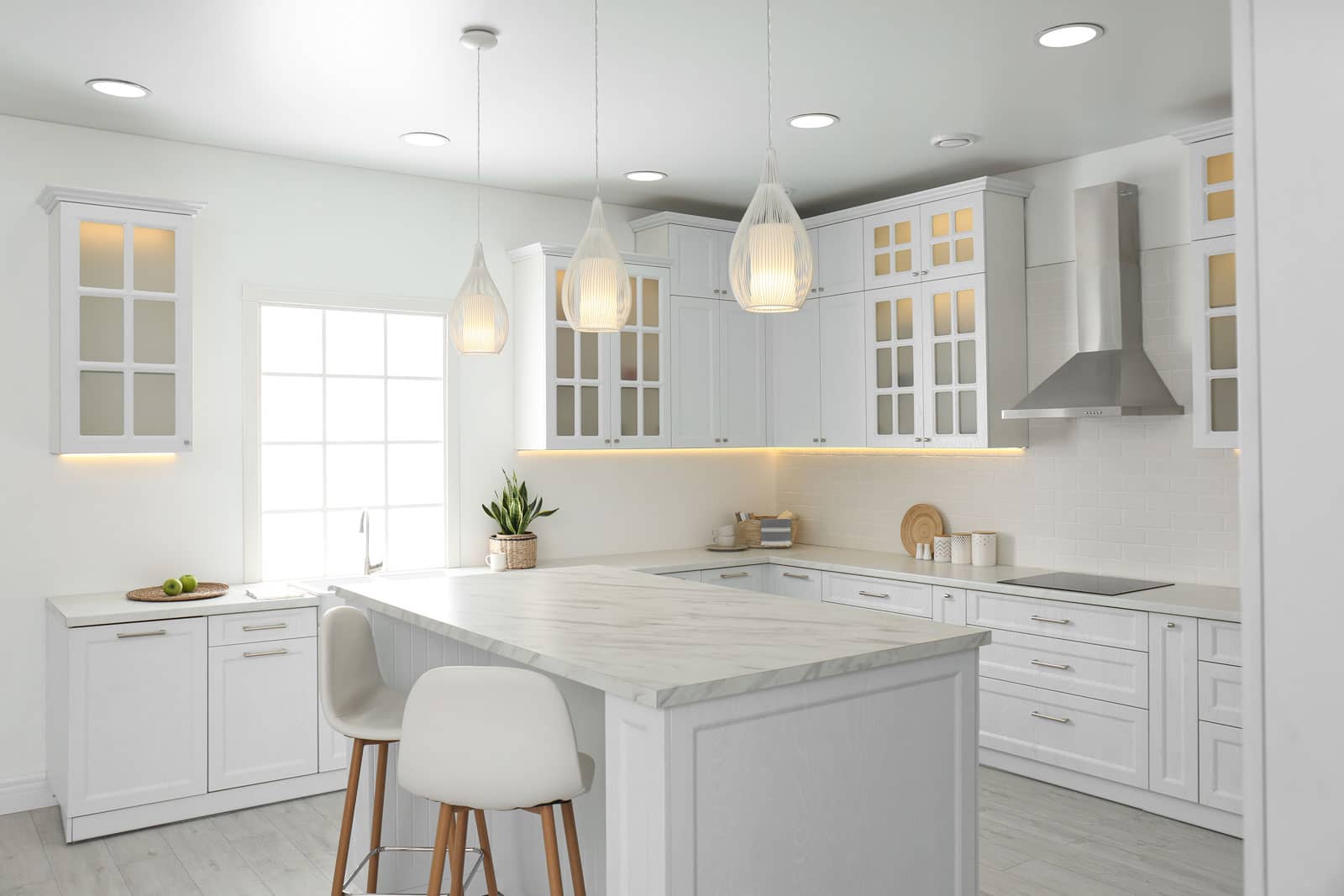
Can You Change Kitchen Unit Doors and Keep Your Existing Cabinets?
Yes. Cabinet boxes rarely wear out from everyday use. The doors and drawer fronts take the punishment: hands, steam, grease, afternoon sun, and thousands of open-and-close cycles. As long as the boxes are square, dry, and structurally sound, you can change kitchen unit doors, add matching drawer fronts and new hinges, and leave everything else in place.
Homeowners usually choose one of three paths:
- Replace the doors and drawer fronts: New fronts on your existing boxes, with the face frames painted to match.
- Reface the cabinets: New doors and drawer fronts plus a matching veneer applied over the face frames and end panels, so every visible surface is new.
- Refinish what you have: Paint or restain the existing doors. The color changes, but the profile doesn’t, so a dated arch stays a dated arch.
If you’re torn between the last two options, our guide to kitchen cabinet refacing vs painting breaks down the pros, cons, and costs of each.
How to Tell If Your Cabinet Boxes Are Worth Keeping
Before you change kitchen unit doors, inspect what’s underneath. Your existing boxes are usually worth saving when:
- Sides and bottoms are plywood, or dry particleboard with no swelling
- Shelves sit flat with no sag in the middle
- Face frames are square and firmly attached to the boxes
- The cabinet floor under the sink feels solid, with no water stains
- The current layout still works for the way you cook and store food
When New Cabinets Make More Sense
New doors can’t fix a cramped work triangle, a missing island, or swollen particleboard under a leaky dishwasher. If you’re moving appliances, changing the layout, or chasing more storage, a full kitchen remodeling project is the better investment. Our article on the steps to remodeling a kitchen in the right order shows how a full project is sequenced, and these ideas to maximize storage in a small kitchen remodel help if space is the real problem.
Mars Brothers Pro Tip: Empty the cabinet under your sink and press firmly on the floor of the box. If it feels soft, spongy, or crumbly, fix the leak and the box first. Beautiful new doors on a failing cabinet are money down the drain.
12 Cabinet Door Styles That Make Old Kitchens Look New
These are the replacement cabinet door styles we recommend most often for Orange County homes, ranging from timeless to trend-forward. You can see many of them, in both face-frame and frameless construction, in our cabinet collection. Use this list to build a shortlist before you change kitchen unit doors, then look at real samples in person, because color and sheen always shift under your own kitchen lighting.
1. Classic Shaker Doors
The five-piece Shaker door, with its square frame and flat recessed panel, is the most versatile replacement style there is. It looks equally at home in modern, transitional, farmhouse, and coastal kitchens, which is exactly why it never seems to go out of style.
- Best for: Nearly any home, especially if resale is on your mind
- Pair with: Bar pulls, cup pulls, and quartz or granite countertops
- Keep in mind: The inside corners collect dust; a smooth painted finish wipes clean more easily
2. Slim Shaker (Skinny Shaker)
Slim Shaker narrows the frame from the traditional 2¼ inches to roughly ¾ to 1¼ inches. It keeps the familiar recessed panel but feels lighter, crisper, and more contemporary.
- Best for: Transitional homes in Irvine, Tustin Ranch, and Lake Forest
- Pair with: Slim brushed-brass or matte black hardware
- Keep in mind: Narrow rails need high-density MDF or hardwood to stay flat and stable
3. Matte Slab Doors
A slab door is a single flat panel with no frame detail at all. In a matte lacquer or painted finish, it delivers a calm, European look that makes compact kitchens feel more open. It’s a cornerstone of the luxury modern kitchen designs we build across Orange County.
- Best for: Condos, contemporary homes, and minimalist designs
- Pair with: Edge pulls or long linear handles
- Keep in mind: Flat surfaces show fingerprints, so ask about anti-fingerprint matte finishes
4. Natural Wood-Grain Slab
Rift-cut white oak, walnut, or a high-quality wood-look laminate on a slab door brings warmth back into kitchens after years of all-white everything. This “warm minimalism” look is one of the most effective ways to change kitchen unit doors without the room feeling cold or clinical, and the same warm-wood slab trend is showing up in modern bathroom cabinets too.
- Best for: Mid-century homes and anyone tired of painted white
- Pair with: Creamy quartz, plaster-look backsplashes, and bronze or black hardware
- Keep in mind: Real wood veneer changes color under strong UV, so sunny coastal kitchens may need window film
5. High-Gloss Acrylic Slab
Glossy acrylic fronts bounce light around the room, which can make a narrow galley kitchen feel dramatically brighter. They resist moisture and wipe clean after a busy weeknight. Pair the right finish with the right color and you multiply the effect; our guide to kitchen cabinet colors that make a small kitchen feel bigger explains which shades work hardest.
- Best for: Galley kitchens, modern condos, and busy family homes
- Pair with: Integrated pulls and waterfall-edge countertops
- Keep in mind: Fine scratches show on dark gloss; white, greige, and soft neutrals hide wear best
6. Fluted and Reeded Doors
Vertical grooves add texture and soft shadow lines without fussy ornamentation. Most of our clients use fluted fronts as an accent on the island, a coffee-bar hutch, or a pair of upper doors rather than on every cabinet in the room.
- Best for: Adding one designer detail to an otherwise simple kitchen
- Pair with: Slab or slim Shaker perimeter cabinets
- Keep in mind: Grooves trap dust, so keep fluting away from the cooktop
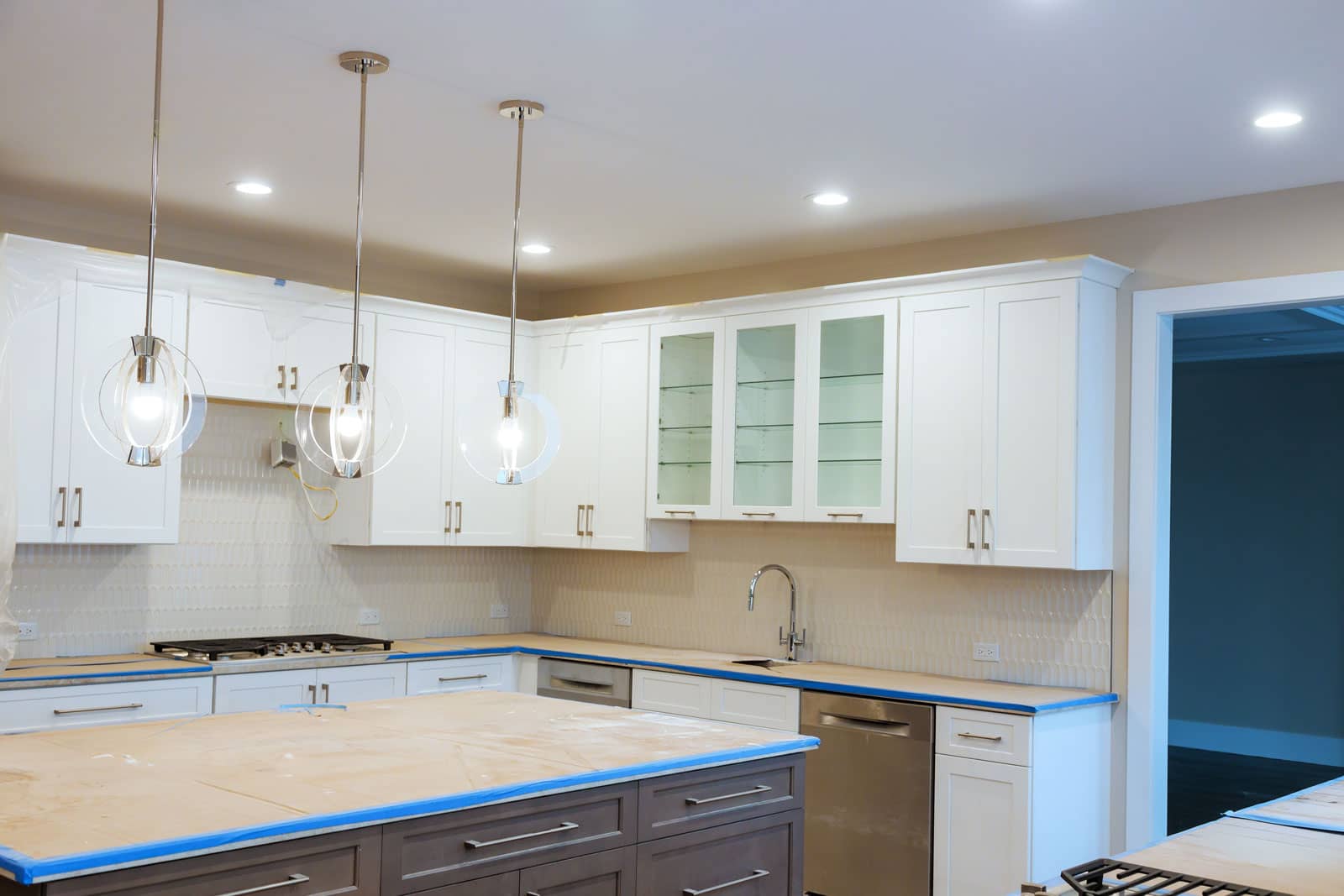
7. Glass-Front Cabinet Doors
Replacing a few solid upper doors with glass inserts (clear, seeded, frosted, or reeded) opens up the room and gives you a place to show off your favorite dishware. It’s one of the most affordable ways to make a run of old upper cabinets feel custom, especially when you coordinate in-cabinet lighting with your kitchen island lighting.
- Best for: Upper cabinets beside a window or flanking a range hood
- Pair with: In-cabinet LED strip lighting
- Keep in mind: Clear glass shows clutter; reeded or frosted glass softens what’s inside
8. Beadboard Doors
Beadboard fronts feature narrow vertical grooves inside a frame for a relaxed, cottage-style feel. In beach communities like Newport Beach, Laguna Beach, and Dana Point, beadboard in soft white or sea-glass blue feels completely natural.
- Best for: Coastal, cottage, and modern farmhouse kitchens
- Pair with: Butcher-block accents and polished nickel hardware
- Keep in mind: Choose one-piece MDF beadboard over separate wood strips, which can open up over time
9. Simplified Raised Panel Doors
Raised panels aren’t dead; they just need editing. A clean, square raised panel with no arch, finished in a modern paint color, reads as elegant and traditional instead of tired. It’s a natural fit for the Spanish and Mediterranean homes found in San Clemente, Yorba Linda, and the city of Orange.
- Best for: Traditional and Mediterranean architecture
- Pair with: Aged brass or oil-rubbed bronze hardware
- Keep in mind: Skip ornate edge profiles if you want the kitchen to feel current
10. Arched Panel Doors
Curves are back, but not the 1990s cathedral arch. Today’s version uses a soft, single radius, applied sparingly: a pair of tall pantry doors, two glass uppers, or an arched open niche over the range. Pair arches with handmade-look tile; our backsplash ideas for small kitchens include several that work beautifully with curves.
- Best for: Creating one focal point in a transitional kitchen
- Pair with: Plaster range hoods and zellige-style tile
- Keep in mind: Limit arches to one or two moments so they look intentional
11. Cane and Rattan Insert Doors
Woven cane panels set into a Shaker-style frame add natural texture and a relaxed, organic feel. They’re a great choice for a butler’s pantry, coffee station, or bar cabinet where you want a bit of personality.
- Best for: Accent cabinets and breakfast nooks
- Pair with: Warm wood tones and green or terracotta paint
- Keep in mind: Cane can sag over time and doesn’t belong near the range, where grease builds up
12. Handleless Doors With Integrated Pulls
Finger pulls routed into the top or bottom edge, or a continuous J-pull profile, remove hardware from the equation entirely. The result is ultra-clean, and there’s nothing for sleeves or small kids to snag.
- Best for: Modern and minimalist kitchens
- Pair with: Slab doors in matte or wood-grain finishes
- Keep in mind: Some designs need push-to-open mechanisms, which add cost
Mars Brothers Pro Tip: Stick to two door styles, maximum, in one kitchen. A pairing we love: slim Shaker on the perimeter with a fluted or wood-grain island. Three or more styles almost always reads as cluttered rather than curated.
Which Material Is Best for New Cabinet Doors?
When you change kitchen unit doors, the material determines how they look in year five, not just on installation day. Here’s how the common options compare:
- Painted MDF: Our first choice for painted Shaker and slab doors. It’s dimensionally stable, so it won’t develop the hairline cracks at the joints that painted solid-wood doors often show when dry Santa Ana winds pull moisture out of the air.
- Solid hardwood: Gorgeous with a stain, but wood expands and contracts with humidity, so it’s better suited to stained finishes than paint.
- Wood veneer over a stable core: Real grain without the movement of solid lumber. Ideal for rift oak and walnut slabs.
- Thermofoil: A budget-friendly vinyl wrap that can peel near ovens and toasters, which is one of the most common reasons homeowners call us.
- Acrylic and high-pressure laminate: Tough, moisture-resistant, and ideal for high-gloss or modern looks.
California adds one more consideration. MDF, particleboard, and hardwood plywood, along with finished goods like cabinets made from them, must meet formaldehyde emission limits under the California Air Resources Board’s Composite Wood Products regulation. Ask any door supplier to confirm their products carry compliant labeling before you buy.
Replace, Reface, or Refinish? A Side-by-Side Comparison
Option | What Changes | Typical Install Time | Best When |
Refinish existing doors | Color only | 4–7 days | The door style still looks current |
Replace doors and drawer fronts | Style, color, hinges | 1–3 days | Boxes and frames are in good shape |
Full cabinet refacing | Doors, fronts, frames, end panels | 3–5 days | You want every surface to match |
New cabinets | Everything, including layout | 4–8 weeks (within a remodel) | The layout or boxes are failing |
For most kitchens we assess, the choice to change kitchen unit doors or reface lands in the sweet spot: a dramatic visual upgrade without losing your kitchen for weeks.
How Much Does It Cost to Change Kitchen Unit Doors in Orange County?
Price depends on door count, material, finish, and whether you’re covering the face frames too. Here are the typical 2026 ranges we see for a standard 25 to 30 door kitchen in Orange County. (Pricing is reviewed annually; your quote will reflect your specific kitchen.)
- Professional refinishing of existing doors: $4,500 to $8,500
- Replacement doors and drawer fronts (semi-custom MDF or laminate): $6,000 to $12,000
- Full cabinet refacing with new hardware: $10,000 to $22,000
- Custom doors in premium species or specialty finishes: $15,000 to $30,000+
- New cabinets, for comparison: $25,000 to $60,000+
Broken down per door, most homeowners who change kitchen unit doors spend roughly $150 to $500 per door installed. For context, cabinetry is often the single biggest line item in a full renovation, as we explain in what is the most expensive part of a kitchen remodel, and our 2026 kitchen remodel cost breakdown shows how door replacement compares with a complete project.
What Pushes the Price Up or Down
- Door count and size: Tall pantry doors and oversized drawer fronts cost more.
- Material: Thermofoil sits at the low end; wood veneer and acrylic sit at the high end.
- Finish: Factory-sprayed lacquer costs more than primed paint-ready doors but lasts far longer.
- Hinges and hardware: Soft-close concealed hinges add cost but transform how the kitchen feels.
- Face-frame work: Refacing or painting the frames to match adds labor.
Want to spread the investment out? Ask us about flexible financing options.

How We Change Kitchen Unit Doors: Step by Step
Whether you hire a pro or simply want to know what a quality job involves, here’s the process our installers follow every time we change kitchen unit doors for a client.
Step 1: Measure Every Door and Drawer Front
Never measure one door and assume the rest match. Older kitchens often have doors that vary by ⅛ inch or more. You also need to confirm your overlay type:
- Full overlay: Doors cover nearly the entire face frame (the modern look)
- Partial overlay: Doors leave part of the frame visible (common in older kitchens)
- Inset: Doors sit inside the frame, flush with its face
Step 2: Match the Hinges to Your Cabinet Construction
Many 1980s and 1990s Orange County kitchens use exposed or semi-concealed hinges. Switching to concealed European hinges with soft-close requires 35mm cup holes bored into the back of each new door, which a good supplier handles at the factory. Getting the hinge right for face-frame versus frameless cabinets is one of the most overlooked details in any door replacement.
Step 3: Protect Your Household During Prep
If your home was built before 1978, plan carefully before you change kitchen unit doors, because the existing paint on face frames and cabinets may contain lead. Under the U.S. EPA’s Renovation, Repair and Painting Program, paid contractors who disturb painted surfaces in pre-1978 homes must be lead-safe certified. That covers a large share of homes in Anaheim, Santa Ana, Garden Grove, Fullerton, and Costa Mesa.
Paint fumes matter too. The EPA explains that paints and varnishes release volatile organic compounds and recommends increasing ventilation whenever you use them. That’s a big reason we prefer factory-finished doors: the spraying and curing happen off-site, not in your kitchen.
Step 4: Install, Align, and Fine-Tune
New doors should hang with consistent gaps (typically about ⅛ inch) and close quietly. Concealed hinges adjust in three directions, so a careful installer fine-tunes every door before calling the job complete.
Step 5: Finish With Hardware and Trim
New pulls, crown molding, light rail, and a matching toe kick tie the whole look together. A drilling template keeps every handle perfectly aligned from one cabinet to the next.
Mars Brothers Pro Tip: Order one or two sample doors before committing to the full set. Hang them for a week and check them in morning light, evening light, and under your under-cabinet lights. Color surprises are the most common regret we hear about.
Pairing Door Styles With Orange County Architecture
Orange County’s housing stock is wonderfully varied, and when you change kitchen unit doors, the best style usually respects the architecture of the house. Here’s how we guide clients across the county:
- Coastal homes (Newport Beach, Laguna Beach, Dana Point, Huntington Beach): White or soft-blue Shaker, beadboard, reeded glass, and light oak tones.
- Master-planned communities (Irvine, Tustin Ranch, Ladera Ranch): Slim Shaker, wood-grain slab, and two-tone kitchens with a contrasting island.
- Mid-century tracts (Orange, Anaheim, Fullerton): Walnut or rift oak slab doors with integrated pulls or simple linear handles.
- Spanish and Mediterranean homes (San Clemente, Yorba Linda, Rancho Santa Margarita): Simplified raised panels, a single arched accent, and warm stained wood.
Want to see these looks in real homes? Browse our project portfolio for finished Orange County kitchens.
Common Mistakes to Avoid When Replacing Kitchen Cabinet Doors
After years of correcting other people’s shortcuts, these are the mistakes we see most often when homeowners change kitchen unit doors without a plan:
- Forgetting drawer fronts and end panels: Mismatched sides make new doors look like an afterthought.
- Going all-in on a trend: Save fluting, cane, and arches for accents; keep the main perimeter timeless.
- Reusing old hinges: Old hinges rarely fit new door thicknesses or overlays properly.
- Ignoring the face frames: New doors beside worn, scuffed frames undermine the entire upgrade.
- Skipping the license check: In California, verify any contractor’s license number with the Contractors State License Board before you sign.
Frequently Asked Questions About Changing Kitchen Cabinet Doors
How long does it take to change kitchen unit doors?
Most door replacement projects take one to three days to install once the doors arrive. Manufacturing lead time typically runs two to six weeks, depending on style and finish. Best of all, your kitchen stays usable throughout, since the boxes, countertops, and appliances never move.
Is it cheaper to replace cabinet doors or buy new cabinets?
Replacing doors and drawer fronts almost always costs far less than new cabinets. In Orange County, door replacement typically runs $6,000 to $12,000 for an average kitchen, while new cabinets often start around $25,000 installed. If your boxes are sound and your layout works, choosing to change kitchen unit doors delivers most of the visual impact at a fraction of the price.
Can you put new doors on old cabinet frames?
Yes. You can change kitchen unit doors on old frames as long as the frames are square, solid, and free of water damage. New doors are sized to your existing openings and overlay, and the hinges are matched to your cabinet construction. We recommend painting or refacing the frames at the same time so everything looks cohesive.
What is the most timeless kitchen cabinet door style?
Shaker is the most timeless choice. Its simple recessed-panel design has stayed popular for generations because it works with almost any countertop, hardware, and color. For something a little more current, slim Shaker offers the same versatility with a cleaner, more modern profile.
Do new cabinet doors increase home value?
New cabinet doors make a kitchen look updated in listing photos and showings, which helps buyers see a home as move-in ready. Because the kitchen is one of the first rooms buyers judge, a fresh, neutral door style is a relatively low-cost way to improve first impressions. For the best return, choose classic styles and finishes over highly personal ones.
Ready to Change Kitchen Unit Doors in Your Orange County Home?
If your cabinets are solid but your kitchen feels dated, new doors may be the fastest, most cost-effective upgrade you can make. The Mars Brothers Kitchen & Bath team will measure your kitchen, check the condition of your cabinet boxes, and walk you through door styles, materials, and finishes in person. Then we’ll give you an honest recommendation, even if that means telling you to keep what you have. Explore all of our kitchen and bath services to see what else we can help with.
Visit our showroom: 1451 Edinger Ave, Suite B, Tustin, CA 92780 Call: (949) 503-0999
Schedule your consultation today and see how much a new set of doors can change your kitchen.