By Libo Shen, Construction Projects Manager, Mars Brothers Kitchen & Bath · October 2026
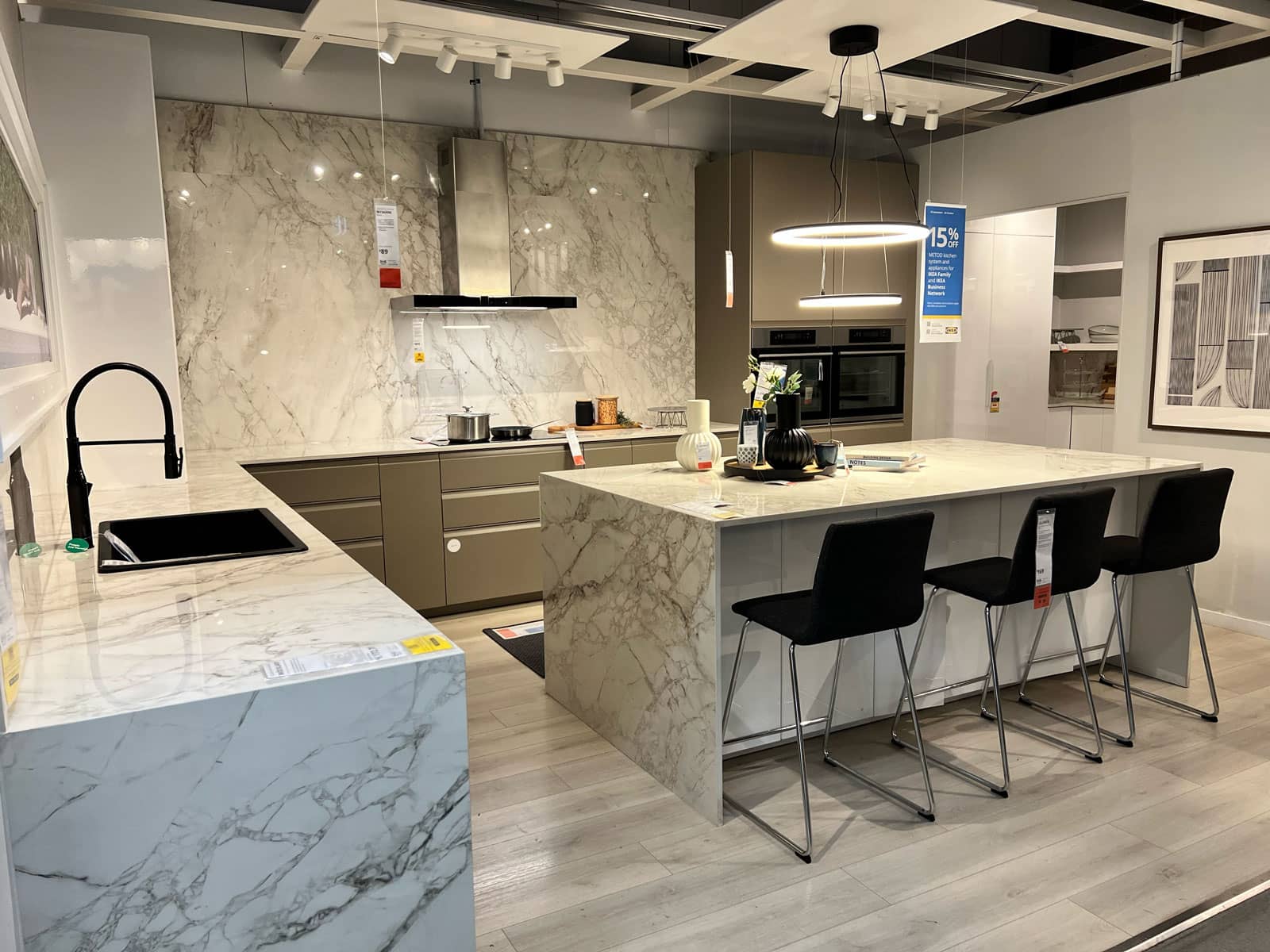
Of all the decisions in a luxury kitchen remodel, the countertop is the one our clients lose the most sleep over. It is the largest finished surface in the room, the first thing guests touch, and the one material you cannot easily swap out later. At our Tustin showroom, the conversation almost always narrows to three slabs laid side by side: a white quartzite with soft gray movement, a porcelain slab printed with bold Calacatta-style veining, and a genuine marble that looks like nothing else on earth.
Each one wins a different argument. Quartzite wins on toughness. Porcelain wins on low maintenance. Marble wins on soul. The right choice depends on how you cook, how much patina you can live with, and even what comes out of your tap here in Orange County.
This guide compares all three the way we evaluate them on real projects in Irvine, Tustin, Newport Beach, and Santa Ana. You will find honest pros and cons, maintenance realities, and 2026 installed pricing for central Orange County, so you can choose the right surface for your luxury kitchen remodel with confidence.
Why Countertops Make or Break a Luxury Kitchen Remodel
Cabinetry sets the structure of a kitchen, but the countertop sets the mood. In a high-end kitchen renovation, the slab carries the color story, frames the island, and often climbs the wall as a full-height backsplash. Choose poorly and you live with etch marks, chipped edges, or a pattern that never suited your cabinets.
Countertops are also where a luxury kitchen remodel budget concentrates. Luxury kitchen countertops are priced per square foot, and on a large kitchen the gap between a standard slab and a rare one can easily reach five figures once you add a waterfall island and a slab backsplash.
What Homeowners Want From High-End Kitchen Countertops in 2026
National data lines up with what we see locally. The 2026 U.S. Houzz Kitchen Trends Study, based on a survey of 1,780 renovating homeowners, found that engineered quartz is still the most popular countertop material overall, with granite and quartzite rounding out the top three. The more telling number is on the wall. When homeowners run a slab up the backsplash, they choose quartzite 33% of the time, close behind engineered quartz at 39%, while marble and porcelain trail at 6% and 4%.
California adds a regulatory twist. In September 2026, Cal/OSHA published a draft emergency regulation that would prohibit fabricating artificial stone containing more than 1% crystalline silica, a threshold most engineered quartz on the market exceeds. The rule was still moving through the rulemaking process as of this writing, but it has already sent many Orange County homeowners back to natural stone and porcelain. For anyone planning a luxury kitchen remodel this year, understanding the differences between quartzite, porcelain, and marble has never mattered more.
Quartzite vs Porcelain Slab vs Marble: Side-by-Side Comparison
Before we go deep on each material, here is how the three compare on the questions clients ask us most when they start a luxury kitchen remodel.
Feature | Quartzite | Porcelain Slab | Marble |
What it is | Natural stone formed from sandstone | Manufactured slab of clays and minerals fired at extreme heat | Natural stone formed from limestone |
Main mineral | Quartz (Mohs 7) | Fired ceramic body | Calcite (Mohs 3) |
Scratch resistance | Excellent | Excellent on the surface | Low |
Lemon, wine, and vinegar | Generally no reaction | No reaction | Etches (dull marks) |
Sealing | About once a year | Never | Every 6 to 12 months |
Heat resistance | Very good | Excellent | Good |
Sun and outdoor use | Good | Excellent | Fair; polish dulls outdoors |
Main weak spot | Cost; mislabeled “soft” stones | Edges can chip | Etching and patina |
2026 OC installed cost | $110 – $275+ per sq ft | $85 – $160 per sq ft | $85 – $300+ per sq ft |
Quartzite Countertops: Natural Stone Built for Real Cooking
What Is Quartzite, and How Is It Different From Marble?
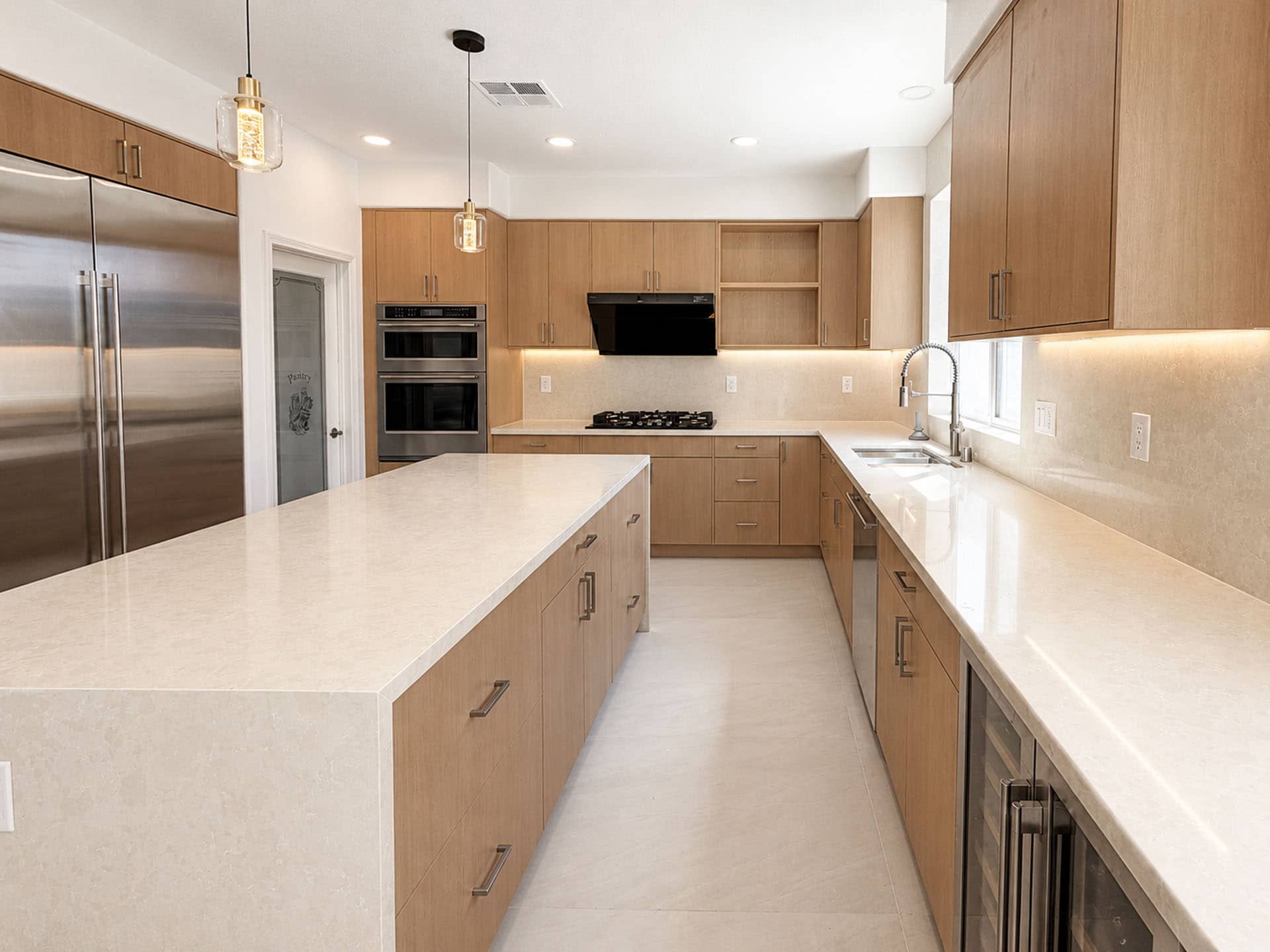
Quartzite and marble are geological cousins. The National Park Service classifies both as non-foliated metamorphic rocks, meaning heat and pressure transformed an older rock into a dense, crystalline stone. The difference is the starting material. Marble began as limestone and is made mostly of calcite. Quartzite began as sandstone, and its quartz grains fused so tightly that it became one of the hardest natural surfaces you can put in a kitchen.
That difference in chemistry decides how each stone behaves at the sink. Quartz rates a 7 on the Mohs hardness scale, harder than window glass or a steel knife blade. Calcite rates a 3. Quartzite gives you the soft white-and-gray movement people love in marble while shrugging off the knife slips and lemon juice that would mark a marble top. For a luxury kitchen remodel where the family actually cooks every night, quartzite is often the sweet spot.
Quartzite Is Not Quartz
The names cause endless confusion. Engineered quartz is a manufactured product made largely of crushed quartz bound with resin, and it typically contains more than 90% crystalline silica. Quartzite is a natural stone cut from a quarry block. Cal/OSHA treats the two differently: the proposed prohibition targets artificial stone, while natural stone stays under California’s existing silica-safety rules for fabrication shops.
For homeowners, the practical point is simple. Silica hazards come from the dust created while slabs are cut, ground, and polished, not from a finished countertop in your kitchen. California requires effective wet methods for that work, so ask any fabricator how they control dust before you hand over your slabs.
Quartzite Countertops: Pros and Cons
Where quartzite shines:
- Hard and scratch-resistant, ideal for heavy prep zones
- Resists etching from most household acids
- Handles heat near the range well
- One-of-a-kind natural veining; no two slabs match
- Stable in sunlight, so it will not yellow near windows
Where it falls short:
- Among the most expensive countertop materials, especially exotic slabs
- Needs periodic sealing, and porosity varies by variety
- Its hardness slows fabrication, which adds labor cost
- Some stones sold as “quartzite” are actually softer dolomite or marble
Mars Brothers Pro Tip: Before approving a quartzite slab, ask the stone yard for an offcut and run two quick tests. First, drag a sharp corner across a piece of glass: true quartzite scratches glass, while marble and dolomite will not. Second, leave a few drops of lemon juice on the polished face for 10 minutes, then wipe it off. A dull spot means the stone will etch in your kitchen too, whatever the label says.

Porcelain Slab Countertops: Low-Maintenance Luxury
Porcelain has earned a permanent place in the luxury kitchen remodel conversation. Today’s large-format slabs carry convincing marble and quartzite veining across surfaces big enough for an entire island.
How Are Porcelain Slabs Made?
Porcelain slabs are made by pressing refined clays, feldspar, and mineral pigments into large sheets and firing them at extreme temperatures. The result is a dense surface that, by industry definition, absorbs 0.5% of its weight in water or less. Countertop slabs most often come in 12 mm or 20 mm thicknesses, with thinner 6 mm sheets used on walls and backsplashes, and many run more than 10 feet long, which means fewer seams on a long island.
Because the surface is nearly non-porous, porcelain slab countertops never need sealing. Coffee, red wine, turmeric, and olive oil wipe away. Porcelain also resists heat and UV fading, which makes it a strong choice for outdoor kitchens and sun-washed coastal rooms.
Inside Our Turtle Rock Porcelain Slab Kitchen
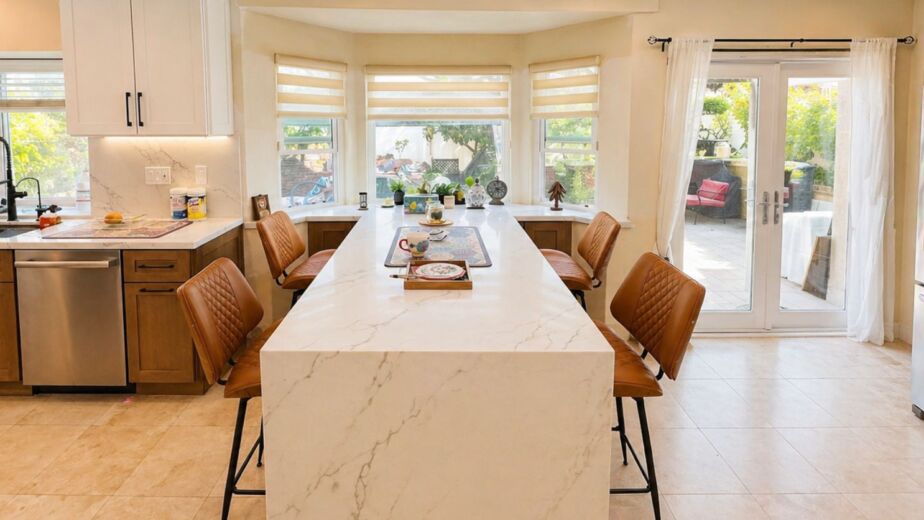
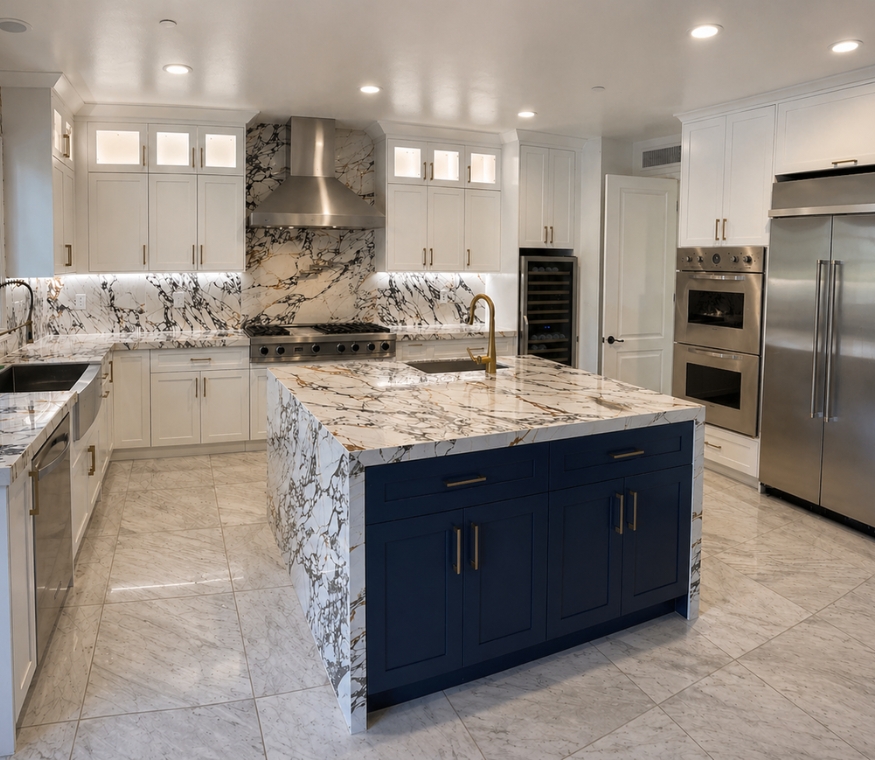
Our Turtle Rock porcelain slab kitchen remodel in Irvine shows what the material can do in a luxury kitchen remodel. The homeowners wanted crisp white shaker cabinetry paired with something far beyond an ordinary countertop, so we sourced a luxury porcelain slab and designed the whole kitchen around it. Frameless cabinets were built to complement the slab’s veining, and a custom waterfall island became the centerpiece of the open-concept layout. The project fell in the $50,000 to $100,000 investment range and was completed in three weeks.
That kitchen also reinforced how demanding porcelain is. It calls for precise cutting, careful handling, and an installer who has done it many times. On a waterfall island, the veining has to flow around the mitered corner, so the cut layout is planned on the full slab before a single cut is made.
Porcelain Slab Countertops: Pros and Cons
Where porcelain shines:
- Zero sealing, ever
- Highly resistant to stains and acids
- Excellent heat and UV resistance, indoors or out
- Large, consistent formats for bookmatched islands and full-height slab backsplashes
- Lighter than stone: 12 mm porcelain weighs roughly a third as much as a 3 cm natural slab
Where it falls short:
- Edges and corners can chip under a hard impact
- On many slabs the veining is printed on the surface, so a chip or a rounded edge exposes a plain body color
- Limited edge profiles; mitered and eased edges work best
- Requires a fabricator with porcelain-specific tooling and experience
Mars Brothers Pro Tip: If you want a thick mitered edge or a waterfall, ask whether the slab has through-body color or veining, meaning the pattern continues into the thickness instead of sitting only on the surface. It costs more, but a small edge chip will blend in instead of flashing a contrasting line.

Marble Countertops: Timeless Beauty With a Living Finish
Why Marble Still Defines High-End Kitchen Design
No manufactured surface fully captures the depth of real Calacatta or Carrara marble. Light travels slightly into the crystals, so the veining seems to glow from within. Marble stays cool to the touch, which bakers love for rolling pastry. In a luxury kitchen remodel, a marble island can be the single element that makes the room feel collected rather than catalog.
Etching, Hard Water, and Marble Countertops in Orange County
Marble’s weakness is chemistry. Calcite reacts with acids, so lemon juice, vinegar, wine, tomato sauce, and many all-purpose cleaners leave dull etch marks, even on sealed stone. Sealing slows staining; it does not prevent etching.
Orange County adds a local twist. In its 2026 Water Quality Report, the Irvine Ranch Water District, which serves all of Irvine and parts of Tustin and Newport Beach, reports average total hardness of 214 to 293 parts per million, depending on the water source. That is well above the 180 mg/L line the U.S. Geological Survey uses to define very hard water. Hard water leaves white mineral spots around the faucet, and the utility notes those deposits can be removed with a simple vinegar solution. That advice works perfectly on a chrome faucet. On a marble countertop, it is exactly what causes etching.
If you choose marble, keep a pH-neutral stone cleaner by the sink, wipe the faucet deck dry after use, and lift mineral spots with a stone-safe product rather than vinegar. Before committing marble to a luxury kitchen remodel, make sure everyone who cleans the kitchen knows the routine.
Honed vs Polished Marble: Which Finish Works Better?
A polished finish makes marble’s veining pop, but every etch shows as a dull patch against the shine. A honed, satin finish hides etching far better because the whole surface is already matte. For working kitchens, we usually recommend honed marble, and many clients come to love the soft patina it develops.
Mars Brothers Pro Tip: Love marble but cook every night? Split the difference. Put marble where it is admired most and abused least, such as a baking station, a bar top, or an island without a sink, and use quartzite or porcelain around the sink and range. A two-material plan also stretches the budget on rare Calacatta slabs.
How Do Quartzite, Porcelain, and Marble Hold Up to Daily Life?
Here is how each surface performs once the luxury kitchen remodel is finished and everyday cooking begins.
Heat, Scratches, and Stains
All three handle kitchen heat better than engineered quartz, whose resin binder can scorch. Still, use a trivet under every hot pan, because a sudden temperature change can crack any slab, especially near a sink or cooktop cutout. On scratches, quartzite and porcelain lead, while marble shows fine scratches and dulls from abrasive grit over time. On stains, porcelain is nearly bulletproof, sealed quartzite is strong, and marble needs quick cleanup.
Sealing and Long-Term Countertop Care
- Quartzite: sealed at installation, then roughly once a year, or sooner when water darkens the stone
- Porcelain slab: no sealer; mild soap and warm water are all it needs
- Marble: sealed at installation and every 6 to 12 months, cleaned only with pH-neutral products
Coastal Sun, Outdoor Kitchens, and Island Overhangs
For outdoor kitchens and rooms that take full afternoon sun, porcelain is the safest choice, since its fired color does not fade. Quartzite also performs well outdoors, while polished marble tends to dull with weather exposure.
Weight matters on big islands. A 3 cm natural stone slab weighs roughly 18 pounds per square foot, so seating overhangs beyond about 10 to 12 inches typically need steel supports. Porcelain is lighter, but thinner slabs need their own support under overhangs, and we follow each manufacturer’s specifications exactly.
How Much Do Luxury Kitchen Countertops Cost in Orange County in 2026?
Countertops are one of the most visible line items in any luxury kitchen remodel budget. The ranges below reflect installed pricing in central Orange County in 2026, including templating, fabrication, a standard edge, and installation. They exclude demolition, plumbing, and backsplash work.
Countertop Material | 2026 OC Installed Cost (per sq ft) | Approx. 60 sq ft Kitchen |
Porcelain slab (12 mm) | $85 – $160 | $5,100 – $9,600 |
Marble, Carrara-type | $85 – $150 | $5,100 – $9,000 |
Quartzite, standard white and gray | $110 – $180 | $6,600 – $10,800 |
Quartzite, premium or exotic | $180 – $275+ | $10,800 – $16,500+ |
Marble, Calacatta or Statuario grade | $150 – $300+ | $9,000 – $18,000+ |
Common luxury add-ons:
- Waterfall island end: $2,500 – $6,000 per side
- Full-height slab backsplash: $3,500 – $10,000
- Mitered edge for a thicker look: $45 – $100 per linear foot
- Bookmatched slab layout: extra material and fabrication time, priced per project
What moves the number:
- Slab rarity and origin, especially for exotic quartzite and top-grade Calacatta
- Number of slabs, driven by island size and vein-matching needs
- Cutouts, mitered edges, and waterfall ends
- Access for carrying heavy slabs, a real factor in hillside and coastal homes
Pricing reflects 2026 Orange County market conditions and is reviewed annually. Your exact figure comes from an itemized written quote after a free consultation, and our financing options can help you choose the slab you love instead of the one that fits this month’s budget.
Which Countertop Is Right for Your Luxury Kitchen Remodel?
There is no single best countertop, only the best fit for the way you live. Use these quick rules as a starting point for your luxury kitchen remodel.
Choose quartzite if you cook daily, want the look of natural stone without marble’s fragility, and are comfortable sealing once a year.
Choose porcelain slab if you want the lowest maintenance, have kids or heavy entertaining traffic, need a matching outdoor kitchen, or want dramatic veining at a more predictable price.
Choose marble if beauty and character come first, you appreciate a surface that evolves with age, and you are willing to follow a simple care routine.
Countertop Choices Across Orange County Neighborhoods
Every luxury kitchen remodel we plan in Orange County starts with the house and the household, and neighborhoods shape the answer:
- Irvine: With very hard water at the tap, we often recommend quartzite or porcelain at the sink for homes in Turtle Rock, Woodbridge, and Northwood, with marble saved for accents. See our approach to kitchen remodeling in Irvine.
- Tustin: Tustin Ranch kitchens from the late 1980s and 1990s often still carry dated tile or first-generation granite. Swapping in quartzite with a slab backsplash transforms them. Learn more about kitchen remodeling in Tustin.
- Newport Beach: Bright coastal light and outdoor entertaining favor porcelain outside and statement marble or quartzite inside. Explore kitchen remodeling in Newport Beach.
- Santa Ana: Busy family kitchens benefit from porcelain’s durability, while honed marble suits the period character of historic French Park and Floral Park homes. Visit kitchen remodeling in Santa Ana.
How We Select and Install Slabs for a Luxury Kitchen Remodel
On every luxury kitchen remodel, the countertop process follows the same sequence, because slabs are expensive, heavy, and unforgiving of shortcuts:
- Design and selection: our in-house designer plans the layout while you compare cabinet finishes and hardware at our Tustin showroom.
- Slab yard visit: you see and tag the exact slabs for your kitchen.
- Layout and vein matching: we plan where seams, waterfall miters, and the best veining will land.
- Templating: precise templates are made after cabinets are installed and leveled.
- Fabrication: slabs are cut by a fabricator experienced with your specific material.
- Installation: seams are placed away from sinks and cooktops where possible, overhangs are supported, and natural stone is sealed.
- Walkthrough and care guide: you receive material-specific cleaning and sealing instructions.
Mars Brothers Pro Tip: Never approve a natural stone slab from a photo. Color, veining, and even background tone vary from slab to slab cut from the same block. Seeing and tagging your actual slabs, then reviewing the layout drawing, is the best insurance against surprises on installation day.
Frequently Asked Questions About Luxury Kitchen Countertops
Is quartzite better than marble for a kitchen?
For most busy kitchens, yes. Quartzite is far harder than marble and resists etching from acidic foods, so it holds up better around the sink and prep areas. Marble offers unmatched veining and a softer, evolving patina, but it needs more care. Many homeowners planning a luxury kitchen remodel use both: quartzite on the working surfaces and marble on a baking station or island.
Do porcelain slab countertops chip easily?
The surface of a porcelain slab is very hard and resists scratches, but edges and corners can chip if struck by a heavy pot or cast iron pan. Choosing an eased or mitered edge, a slab with through-body color, and an experienced porcelain fabricator reduces the risk considerably. Small chips can be filled, though repairs are rarely invisible.
How much do luxury kitchen countertops cost in Orange County?
In 2026, installed prices in central Orange County typically run $85 to $160 per square foot for porcelain slab, $110 to $275 or more for quartzite, and $85 to $300 or more for marble, depending on grade. A luxury kitchen remodel with about 60 square feet of countertops usually lands between $5,100 and $18,000 for the counters alone, before waterfall ends and slab backsplashes.
How often should quartzite and marble countertops be sealed?
Quartzite generally needs sealing about once a year, and marble every 6 to 12 months in an active kitchen. The quick test is a few drops of water: if the stone darkens within roughly 10 minutes, reseal. Porcelain slab never needs sealing. Remember that sealing protects marble from stains, not from acid etching.
Does California's proposed engineered stone ban affect quartzite, marble, or porcelain?
Cal/OSHA’s September 2026 draft regulation targets artificial stone, the engineered quartz products containing more than 1% crystalline silica. Cal/OSHA classifies natural stone and sintered stone separately from artificial stone, and fabrication shops must still follow California’s existing silica-safety rules when cutting them. The rule was still in the rulemaking process as of October 2026, so check its status before you order.
Start Your Luxury Kitchen Remodel With Mars Brothers Kitchen & Bath
Quartzite, porcelain, and marble can all anchor a stunning kitchen. The right one depends on your cooking habits, your tolerance for patina, and the look you want to live with for the next twenty years. Our in-house designer and installation crew guide every luxury kitchen remodel from the first sketch to the final walkthrough. Browse our kitchen remodeling services and recent projects, and if you are still weighing cabinet finishes, our guide to white oak cabinets in Irvine and Tustin remodels pairs well with all three stones.
Ready to see the slabs side by side? Visit our Tustin showroom and start planning your luxury kitchen remodel in person.
- Call: (949) 503-0999
- Website: marsbrokitchenbath.com
- Instagram: @marsbrotherskitchenbath
- Showroom: 1451 Edinger Ave., Ste B, Tustin, CA 92780
Book your free design consultation today. Mars Brothers Kitchen & Bath: Build Your Space. Love Your Place.