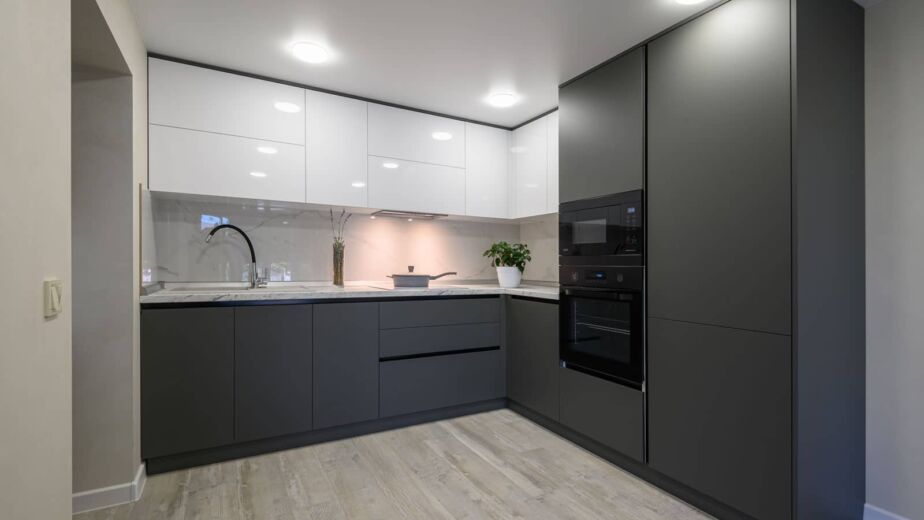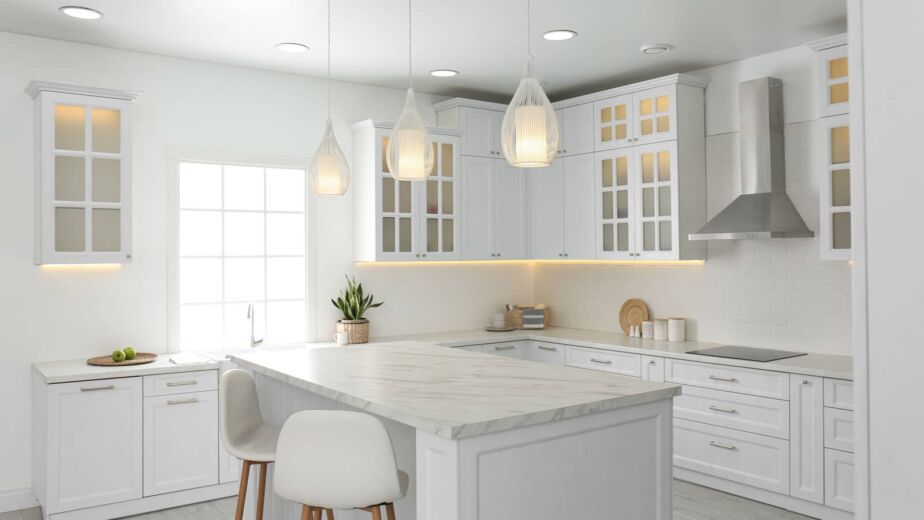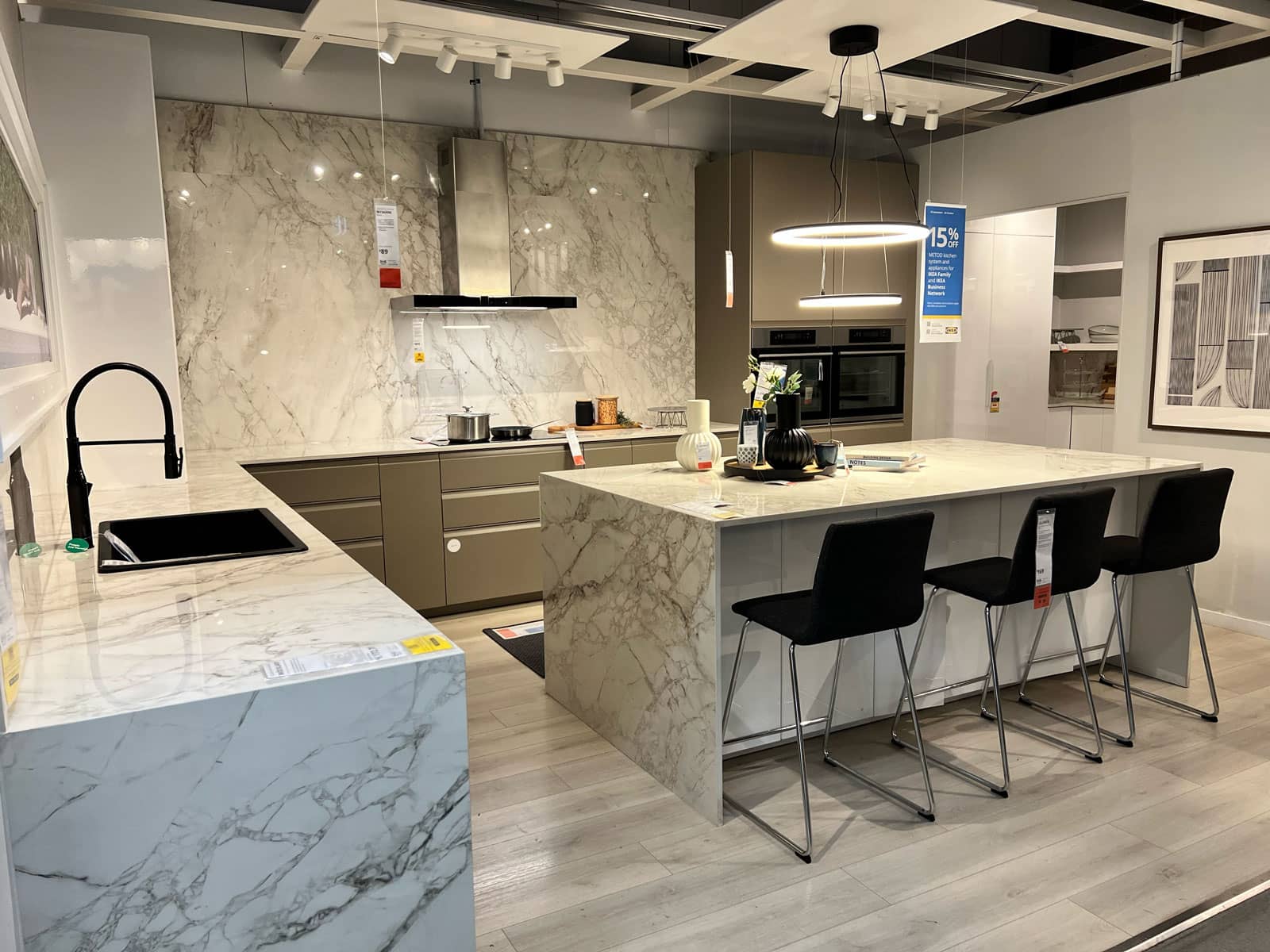
On nearly every backyard build we take on across Orange County, there’s a turning point. The homeowner stops fixating on the grill and starts studying the cabinets – and that’s the smart move. The outdoor kitchen cabinet you choose is the one decision that quietly decides whether your patio still looks showroom-fresh ten summers from now, or starts warping, rusting, and swelling by the second one.
At Mars Brothers Kitchen & Bath, nine years and almost 300 completed remodels have taught us exactly what holds up in a Southern California backyard and what doesn’t. Salt-laced coastal air, unforgiving UV, sprinkler overspray, and wild temperature swings between a July afternoon and a January night punish the wrong materials fast. So before a finish wins your heart, let’s run through 18 outdoor kitchen cabinet ideas that pair real beauty with the kind of durability we trust on patios from Tustin to Newport Beach.
Why an Outdoor Kitchen Cabinet Behaves Nothing Like Indoor Cabinetry
The most expensive mistake we get called in to fix is a simple one: someone installs ordinary indoor cabinets – MDF boxes, particleboard, veneered plywood – beneath a patio cover and assumes the roof will protect them. One season later the doors droop, the finish blisters, and rust bleeds down the fronts from the fasteners.
Indoor cabinets live in a sealed, climate-controlled room. An outdoor kitchen cabinet lives in the weather itself. It has to fend off humidity, baking sun, constant expansion and contraction, and – near the coast – chloride-rich air that chews through unprotected metal. That’s exactly why the materials, hardware, and joinery used in weatherproof outdoor cabinetry are built on a different rulebook than anything the same crew installs during a typical kitchen remodeling project indoors.
The upside is that this category has grown up. Modern weather-resistant outdoor cabinetry now comes in colors and finishes that rival – and frequently outshine – what most people put inside their homes.
Mars Brothers Pro Tip: “Covered” does not mean “protected.” A roofed patio still breathes the same humid, salty air as an open one, so the failure point is almost always the material, not raindrops. We spec fully rated outdoor cabinetry even for covered builds.

What Makes an Outdoor Kitchen Cabinet Genuinely Durable? (The Materials That Last)
Before the ideas, a quick primer on the four material families that actually earn backyard duty. Almost every long-lasting outdoor kitchen cabinet we set is built from one of these.
Marine-Grade Stainless Steel (304 vs. 316)
Stainless is the backbone of outdoor cabinetry, but the grade counts far more than the sheen. Type 304 – the familiar “18-8” in most appliances – fights corrosion well inland. Type 316, known as marine grade, adds 2–3% molybdenum, which sharply improves resistance to the chloride pitting caused by ocean air.
- Inland OC (Anaheim Hills, Orange, Yorba Linda): 304 stainless is typically all you need.
- Coastal OC (Newport, Laguna, Huntington, Corona del Mar): move up to 316 marine grade so salt spray doesn’t leave rust freckles by year two.
Keep the fabricator’s mantra in mind: stainless is stain-less, not stain-proof. An occasional wipe keeps that protective chromium layer working.
Marine-Grade Polymer (HDPE)
High-density polyethylene – the UV-stabilized material behind premium outdoor furniture and marine dock hardware – makes an outstanding weatherproof cabinet box. It won’t rust, rot, or swell, and because the color runs all the way through, a scratch never exposes a different shade beneath. The palette now spans driftwood grays, deep navy, and matte black.
Powder-Coated Aluminum
Aluminum can’t rust, and a powder coat wraps it in a tough, UV-stable finish in nearly any color. It’s light enough for rooftop decks and second-story balconies and delivers the crisp, contemporary edge that suits so much Orange County architecture.
Naturally Durable Woods and Teak
Want the warmth of real timber? Choose species with true decay resistance instead of standard lumber. The U.S. Department of Agriculture’s Forest Products Laboratory Wood Handbook explains that naturally durable woods resist decay thanks to protective chemical extractives concentrated in the heartwood – and only the heartwood carries that armor. Teak, western red cedar, redwood, and white oak all rate resistant to very resistant. Oregon State University’s published durability checklist is a dependable species reference, and the American Wood Council confirms cedar, black locust, and redwood lead the domestic field. Even so, durable wood needs annual sealing to stay at its best.
Mars Brothers Pro Tip: Whatever the box is made of, we use 316-grade stainless hinges, slides, and fasteners on every outdoor kitchen cabinet – even on polymer or wood builds. Hardware is where most “waterproof” cabinets quietly fail first.
18 Outdoor Kitchen Cabinet Ideas Worth Stealing
Here’s the enjoyable part. These are the backyard cabinetry ideas we return to again and again because they photograph beautifully and survive real life. You can see many of them in our project portfolio. Mix and match a few and your outdoor kitchen cabinet layout will feel custom without a custom-only budget.
1. Marine-Grade Stainless Steel Base Cabinets
The timeless pick. A run of brushed stainless base cabinets reads clean and professional, masks fingerprints better than polished finishes, and partners with any countertop. For coastal builds we spec 316 and often add a powder coat as extra insurance against tea-staining.
2. Weatherproof HDPE Polymer Cabinets in Coastal Colors
For homeowners who want color without upkeep, polymer is our go-to weatherproof outdoor cabinetry. A soft coastal gray or a confident navy front hands a backyard kitchen instant personality – and you’ll never sand, seal, or repaint it.
3. Powder-Coated Aluminum Cabinetry for a Modern Look
Matte-black powder-coated aluminum against a pale stone counter is one of the most-requested looks in Irvine and Newport Coast right now. Rust-proof, light, and razor-sharp in profile, it’s a contemporary cabinet system that ages with grace.
4. Teak Outdoor Kitchen Cabinets for Warm, Natural Texture
When a client wants the space to read as an extension of a mid-century or organic-modern home, teak brings unmatched warmth. Leave it natural and it weathers to a refined silver-gray; seal it regularly and it holds a golden glow. It’s the most furniture-like outdoor cabinetry option there is.
5. Stucco-and-Tile Masonry Cabinet Runs
The Southern California staple. A stucco-clad masonry base capped with decorative tile ties the whole build to the house and buries every mechanical inside a permanent, weatherproof structure. We set stainless access doors and drawers into the masonry so you keep genuine storage.
6. Concrete Block (CMU) Frames With Stone Veneer
A CMU-framed island dressed in stacked-stone or brick veneer is virtually indestructible. This approach turns your cabinetry run into a landscape feature – perfect for larger yards where the kitchen anchors the entire patio.
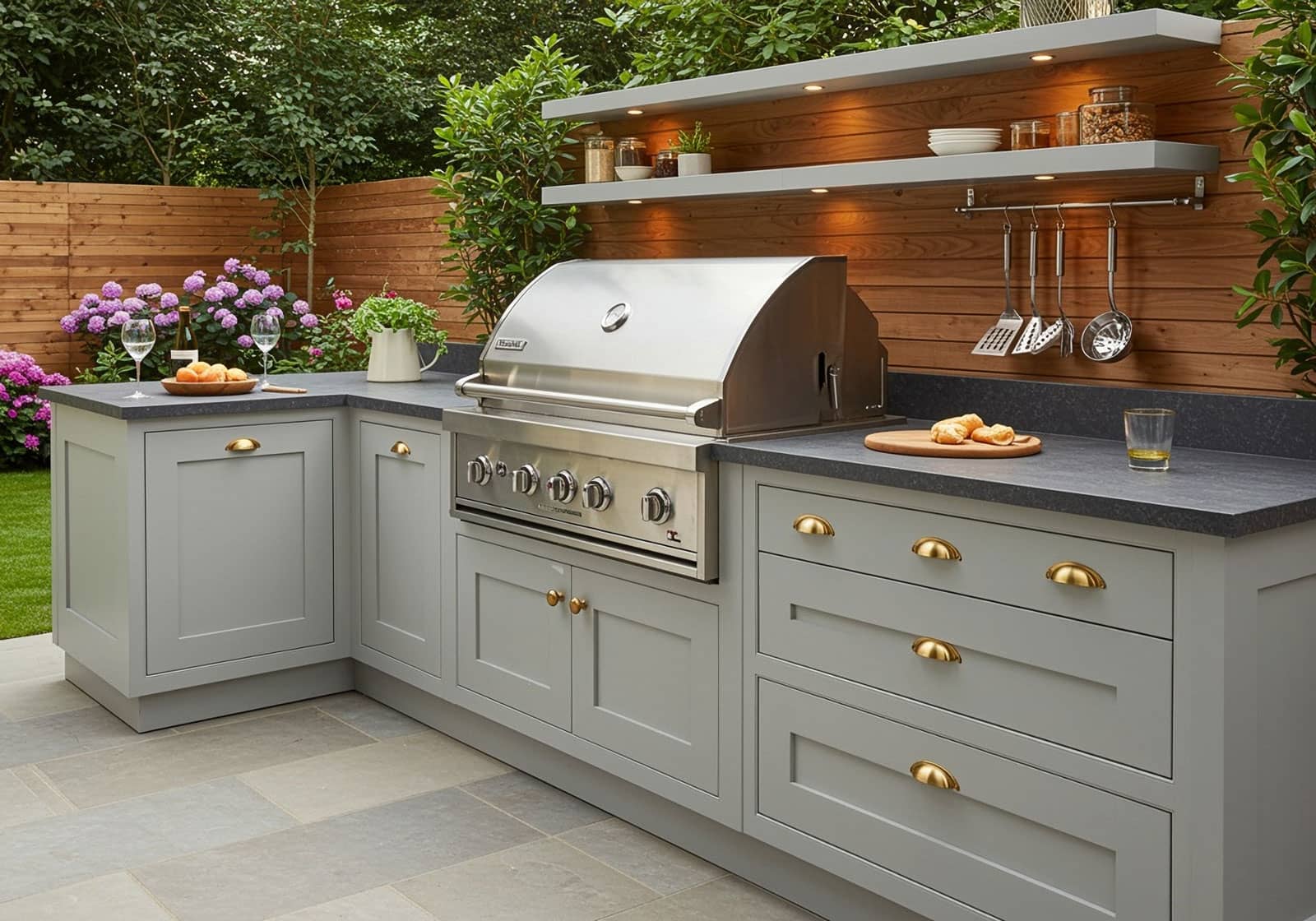
7. Built-In Grill Cabinet With Proper Ventilation
Your grill surround isn’t just a slot for the grill – it needs ventilation cutouts to safely release trapped gas and heat. We frame a dedicated enclosure with stainless access doors on both sides, so the hardest-working appliance is flanked by the storage you reach for most.
8. Two-Tone Cabinet Fronts to Match Your Home’s Exterior
Pair a neutral perimeter with an accent island – say, warm wood-look polymer against stainless – to break up a long run and echo interior kitchen trends. It’s the simplest way to make a backyard cabinet layout feel bespoke.
9. Full-Height Pantry and Tower Cabinets for Outdoor Storage
Most backyard kitchens are all base cabinets and zero vertical storage. A weatherproof tower cabinet gives platters, tools, propane, and paper goods a home – so you’re not sprinting inside every ten minutes.
10. Under-Counter Appliance Cabinets With Precise Cutouts
Refrigerators, ice makers, kegerators, and warming drawers each demand exact, ventilated openings. Building the cabinet boxes around the appliance specs – rather than forcing appliances into generic boxes – is the line between a flush, integrated look and an obvious afterthought.
11. Louvered Doors for Airflow and Propane Storage
Louvered doors circulate air around gas components and let any pooled propane escape from the base of a cabinet. It’s a genuine safety feature that also looks sharp, adding shadow-line texture to an otherwise flat run.
12. Open Shelving Plus Closed Cabinet Combination
Not everything needs a door. A few stainless open shelves for the grab-constantly items – tongs, oils, a stack of plates – alongside closed weather-resistant cabinets for the rest keeps the space practical and visually airy.
13. Drawer-Heavy Base Cabinets (Deep Drawers Over Doors)
We steer nearly every client toward more drawers and fewer doors. Deep, full-extension stainless drawers make the back corners of a base cabinet genuinely usable – no more spelunking into a dark box for whatever slid to the rear.
14. Weatherproof Sink Cabinet With Plumbing Access
An outdoor sink changes how a backyard kitchen works, but the cabinet under it needs a hinged or removable panel for plumbing and freeze protection. We build sink cabinets with sloped, sealed bases so drips drain out instead of pooling.
15. Bar Cabinet With Integrated Ice Bin and Bottle Storage
Carve out one zone for entertaining: a drop-in ice bin, a speed rail for bottles, and a compact stainless sink turn the corner of your cabinetry run into a proper backyard bar. It’s reliably the busiest station at every party our clients throw.
16. Kamado or Pizza Oven Surround Cabinet
If a kamado or wood-fired pizza oven is the star, frame it with a heat-rated surround in masonry or stainless. Keep combustibles well clear of the firebox and give the unit room to breathe – this is one build where clearances are non-negotiable.
17. Waterfall-Edge Island Cabinet in Porcelain or Quartzite
For a true showpiece island, wrap the outdoor kitchen cabinet in a waterfall-edge slab of porcelain or quartzite. Porcelain especially is UV-stable, fade-proof, and stain-resistant – a surface that looks like natural stone but performs like a weatherproof one.
18. Trash and Recycling Pull-Out Cabinet (The One Everyone Forgets)
The most overlooked idea here. A dedicated pull-out for trash and recycling keeps bins off the patio, out of sight, and away from the dining zone. Every homeowner who adds one tells us they wish they’d done it sooner.

What Do Outdoor Kitchen Cabinets Cost in Orange County? (2026 Pricing)
Budget is always the next question, so here’s honest, current guidance straight from our Orange County job sites. (These are 2026 OC ranges that move with material and labor costs – planning figures, not quotes.)
- Value tier – powder-coated aluminum or basic polymer: roughly $450–$800 per linear foot, installed. Strong durability, modern looks, easy on the wallet.
- Mid tier – 304 stainless steel cabinetry: roughly $800–$1,300 per linear foot, installed. The sweet spot for most inland OC backyards.
- Premium tier – 316 marine-grade stainless, custom masonry, or teak: $1,300–$2,200+ per linear foot, installed. Built for coastal exposure and long-term, low-worry ownership.
A typical L-shaped backyard kitchen – around 12 to 16 linear feet of cabinetry with a grill, a fridge, and a sink – usually lands between $9,000 and $28,000 for the cabinet package, before appliances and countertops. Coastal builds sit at the top because marine-grade materials cost more up front and save far more over time. If the numbers feel steep, ask us about financing options – most projects are more attainable than homeowners expect.
Mars Brothers Pro Tip: Spend where the weather hits hardest. On a tight budget, we’ll put premium 316 hardware and a marine-grade sink cabinet where water lives, then use value-tier material for the dry storage runs. Smart allocation beats spreading a thin budget evenly.
Outdoor Kitchen Cabinet Materials, Side by Side: Which Should You Choose?
If you remember only one thing, make it this quick decision guide:
- Pick 316 stainless or marine-grade polymer within a few miles of the coast. Salt air is the great destroyer, and these two shrug it off.
- Pick 304 stainless or powder-coated aluminum for inland OC, where sun and heat – not chloride – are the main threats.
- Pick masonry when you want a permanent, architectural anchor and don’t mind a larger build.
- Pick teak or durable hardwood when warmth and natural grain matter more than zero maintenance, and you’ll commit to yearly sealing.
There’s no universal “best” outdoor cabinetry material – only the best match for your microclimate, your style, and the upkeep you’re willing to sign up for. Browse the cabinet lines we carry to see finishes in person.
Should You Buy Prefab or Custom Cabinetry for Your Backyard?
One question surfaces on almost every consultation: prefabricated modular units or a fully custom build? Both have their place; the right call depends on your yard, your budget, and how particular you are about fit.
Prefabricated (modular) units arrive as pre-built weatherproof boxes in standard widths that you set and level. They install faster, budget cleanly, and suit straight runs and simple layouts. The trade-off is flexibility – standard sizes rarely fill an irregular space perfectly, so you often end up with a filler panel or a visible gap where a wall meets an appliance.
Custom cabinetry is built to your exact dimensions, appliances, and finishes. It’s the route we recommend for curved islands, tight side yards, sloped grades, and any build meant to feel truly integrated with the home. Custom also solves the awkward problems – an odd corner, a utility access panel, a specific coastal spec – that modular systems simply can’t.
Here’s how we usually frame it:
- Go prefab for a quicker, more affordable build in a standard rectangular layout, if you’re comfortable with catalog sizes and finishes.
- Go custom if your space is irregular, you’re near the coast and need specific marine-grade materials, or you want a result that looks architect-designed rather than assembled.
A hybrid works beautifully too. On plenty of Orange County projects we drop modular boxes into the straightforward runs and build custom pieces for the island or appliance wall – capturing most of the savings while nailing a tailored fit where it shows. Whichever path you take, the earlier material and hardware rules still hold: an outdoor kitchen cabinet is only as durable as the weakest fastener holding it together.
Design and Layout Tips From Our Orange County Job Sites
Great materials still need great execution. A few hard-won lessons from building weatherproof outdoor kitchen cabinet runs across the county:
- Plan ventilation first. Any cabinet housing a gas appliance or fuel needs airflow. Trapped gas is a safety matter, not a style one.
- Respect appliance clearances. Grills, side burners, and pizza ovens each specify minimum distances to combustibles. We build to the manufacturer’s spec every time.
- Design for drainage. Sloped, sealed cabinet bases and weep points push water out instead of letting it collect where it corrodes hardware.
- Mind the door swing and traffic flow. A cabinet door that opens into a walkway will irritate you at every gathering, so we map the whole zone before we build.
- Match the house, not the catalog. The most timeless backyard kitchens borrow finishes and lines from the home’s exterior so the space feels intentional rather than bolted on.
Beyond the cabinets, appliance efficiency matters too – the U.S. Department of Energy’s ENERGY STAR program is a solid reference when you’re choosing an outdoor refrigerator or ice maker to tuck into your cabinetry.

Frequently Asked Questions About Outdoor Kitchen Cabinets
What is the most durable material for an outdoor kitchen cabinet?
For coastal Orange County, 316 marine-grade stainless steel and marine-grade HDPE polymer are the two most durable choices. The 316 stainless resists salt-air pitting thanks to its molybdenum content, while polymer can’t rust or rot at all. Inland, 304 stainless and powder-coated aluminum both perform superbly against sun and heat. Whatever box material you choose, insist on 316-grade stainless hardware – hinges and slides are usually the first thing to fail.
Can I use regular indoor kitchen cabinets outside if they're covered?
No – and it’s the most common, costly mistake we’re called in to fix. Standard indoor cabinets use MDF, particleboard, or veneered plywood that swell, warp, and delaminate once exposed to humidity and temperature swings, even under a patio cover. A covered patio breathes the same outdoor air. Always specify cabinetry rated for outdoor use.
How much does it cost to build an outdoor kitchen with cabinets in Orange County?
As of 2026, outdoor cabinetry in Orange County runs roughly $450–$800 per linear foot for value-tier polymer or aluminum, $800–$1,300 for 304 stainless, and $1,300–$2,200+ for 316 marine-grade or custom masonry, installed. A typical mid-size backyard kitchen cabinet package lands between about $9,000 and $28,000 before appliances and countertops.
Do outdoor kitchen cabinets need ventilation?
Yes – especially any cabinet housing a gas grill, side burner, or propane tank. Ventilation cutouts and louvered doors let heat escape and stop gas from collecting in an enclosed space, which is a real safety concern. We design airflow into every gas-adjacent cabinet as standard practice, not an upgrade.
How do I maintain and clean outdoor kitchen cabinetry?
It depends on the material. Stainless steel needs a periodic wipe with a mild cleaner and a soft cloth (follow the grain) to preserve its protective layer and prevent staining. Polymer and powder-coated aluminum usually need only soap and water. Naturally durable woods like teak should be cleaned and re-sealed about once a year to hold their color and repel moisture. A few minutes of seasonal care keeps a well-built outdoor kitchen cabinet looking new for a decade or more.
Ready to Design Your Backyard Kitchen?
The right outdoor kitchen cabinet turns a patio into the room your family actually lives in all summer. After nearly 300 remodels across 28 Orange County cities – from kitchens and bathrooms to full home transformations – our team knows precisely which materials survive our climate and how to make them look stunning while they do it.
Mars Brothers Kitchen & Bath would love to help you plan a beautiful, durable backyard space from concept to completion.