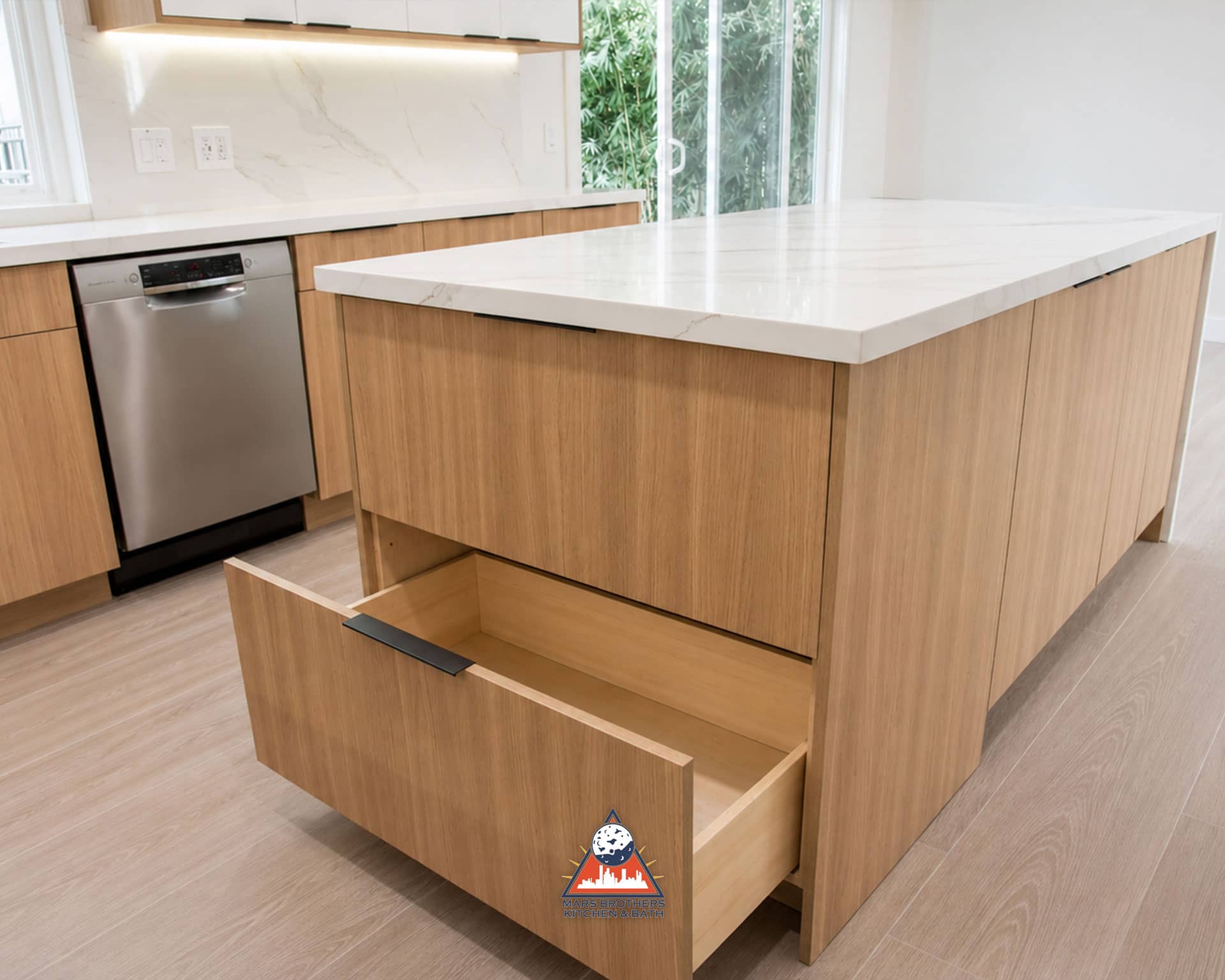
Open any lower cabinet in a 1990s Orange County kitchen and you already know the routine. You kneel on the tile, push the colander aside to reach the stockpot, and pull out three pans to get the one you actually need. Then you put everything back. That small daily frustration is why the question of kitchen cabinet drawers vs doors has become one of the first conversations we have with nearly every remodeling client.
At our Tustin showroom, homeowners open a door base and a drawer base side by side, load them with cookware, and feel the difference in about ten seconds. Most walk out leaning toward kitchen cabinet drawers. But drawers are not automatically the right answer for every base cabinet, and they cost more. A sink base, a blind corner, or a cabinet built for sheet pans may serve you better with a door.
This guide breaks down the real trade-offs the way we plan them on job sites from Tustin and Irvine to Newport Beach and Santa Ana: how each cabinet works, where kitchen cabinet drawers earn their price, where doors still win, what separates a good drawer from a bad one, and what each option costs in Orange County in 2026.
Quick answer: For most base cabinets, kitchen cabinet drawers are worth the extra cost. Deep drawers let you see and reach everything without kneeling, and they put more of the cabinet’s volume within easy reach than shelves behind a door. Keep doors where plumbing, corners, or tall flat items make drawers impractical, mainly the sink base and blind corners, and use roll-out shelves when you want a lower-cost middle ground.
What Is the Difference Between Drawer Base Cabinets and Door Base Cabinets?
Both start as the same box: typically 34½ inches tall and 24 inches deep, sitting on a toe kick, with the countertop bringing the work surface to about 36 inches. What changes is how you get to what is inside.
How a Standard Door Base Cabinet Is Built
A door base usually has one drawer across the top and one or two doors below, with a single adjustable shelf inside. Widths run from 9 to 36 inches in 3-inch increments, and anything 24 inches or wider normally gets a pair of doors. In a face-frame cabinet, those pairs often meet at a center stile, a vertical strip of wood that narrows the opening right where you need to slide a wide pan through.
The floor of a door base sits just above the toe kick, so the lowest shelf is only about 5 to 6 inches off your kitchen floor. That detail matters more than most people expect, as you will see below.
How Drawer Base Cabinets Are Configured
A drawer base replaces the doors and shelf with stacked drawers. The most common layouts we install are:
- Three-drawer base: a shallow top drawer for utensils and two deep drawers for pots, pans, and food storage containers
- Four-drawer base: four equal or graduated drawers, ideal for linens, foil and wraps, baking tools, and spices
- Two-drawer pot-and-pan base: two very deep drawers for stockpots, Dutch ovens, and small appliances
- Drawer-in-drawer base: a hidden interior drawer behind a deep front, so cutlery sits above cookware in the same opening
With kitchen cabinet drawers, the entire contents slide out to you. With a door, you reach into the cabinet and go looking for them.

Are Roll-Out Shelves a Good Compromise Between Drawers and Doors?
Roll-out shelves, also called pull-out trays, are shallow trays on slides that sit behind a cabinet door. You open the door, then pull the tray toward you. They sit halfway between a fixed shelf and a true drawer base, and they can be added to many existing cabinets.
Where roll-outs shine:
- Lower cost than a full drawer base, especially as a retrofit
- They bring contents out of the dark back corners
- They work behind existing doors, so the look of the kitchen does not change
Where they fall short:
- Two motions to reach anything: open the door, then pull the tray
- Doors must swing open far enough, or the tray hits the door or hinge
- In face-frame cabinets, the frame and center stile reduce usable tray width
- Low tray sides mean tall items can tip over when the tray moves
Our view: roll-outs are a smart upgrade inside a sink base or a pantry cabinet. In the main cooking zone, where you reach for pots several times a day, true kitchen cabinet drawers are faster and easier.
Mars Brothers Pro Tip: If you are keeping your existing cabinet boxes and only replacing the fronts, ask us whether your door bases can be converted to drawer bases. In solid plywood boxes, we can often remove the shelf and center stile, install new slides and dovetail boxes, and add matching drawer fronts. Our guide to changing kitchen unit door styles explains when updating fronts instead of replacing cabinets makes sense.
What Makes Quality Kitchen Cabinet Drawers? Slides, Boxes, and Construction
Not every drawer is worth the upgrade. A cheap drawer that sags, sticks, or only opens three-quarters of the way loses most of its advantage over a door. These are the specifications we check on every quote, and the ones worth asking about when you compare bids.
Full-Extension vs. Three-Quarter-Extension Slides
Full-extension slides let the drawer open to its entire depth, so you can reach the back row of lids without feeling around. Three-quarter slides leave the last several inches inside the cabinet, which brings back the hidden-storage problem you were trying to solve. For deep pot drawers, full extension is non-negotiable.
Undermount vs. Side-Mount Drawer Slides
- Undermount slides mount beneath the drawer box and stay hidden. They usually include soft-close, run quietly, and give the drawer a cleaner, more furniture-like look.
- Side-mount slides attach to the sides of the box, are visible when the drawer is open, and cost less. Good ball-bearing side-mounts are durable, but they lack the same smooth, quiet feel.
Check the load rating, too. Standard slides are commonly rated somewhere around 75 to 100 pounds, which is plenty for utensils and everyday dishes. For a wide drawer loaded with cast iron or a stand mixer, we specify heavy-duty slides rated well above that.
Drawer Box Construction
The drawer box takes the daily abuse, so look for:
- Solid wood or Baltic birch plywood sides, roughly 1/2 to 5/8 inch thick
- Dovetail joints, which resist pulling apart under heavy loads
- A bottom captured in a groove on all sides, not just stapled underneath
Particleboard boxes with stapled bottoms are the most common reason budget kitchen cabinet drawers fail within a few years. The bottom bows, the front loosens, and the drawer starts to drag.
Face-Frame vs. Frameless Cabinets
In a face-frame cabinet, the frame narrows the opening, so the drawer box is narrower than the cabinet itself. Frameless, or European-style, cabinets have no frame, so drawer boxes can run nearly the full interior width. If you want the most storage from your kitchen cabinet drawers, frameless construction gives you a measurable edge, especially in wider bases. You can compare both construction styles, along with slide types and drawer boxes, at our Tustin cabinet showroom.

Safety Considerations for Orange County Families
Kitchen cabinet drawers change how a kitchen behaves around small children and during an earthquake, and both deserve a plan before the cabinets are ordered.
Childproofing Kitchen Drawers
Open drawers can work like stair steps for a curious toddler, and lower drawers put knives, foil cutters, and cleaning products at a child’s eye level. The U.S. Consumer Product Safety Commission includes safety latches on kitchen and bathroom cabinets among its recommended low-cost devices for preventing poisonings in homes with young children.
We build child safety into the layout itself: knives in an upper drawer or a locking insert, cleaners in the sink base behind a latched door, and lock hardware that actually fits the cabinet type. Many stick-on latches are designed for face-frame cabinets and will not grip a frameless box, so it pays to choose compatible locks before move-in day.
Earthquake-Ready Drawers and Doors
Southern California kitchens need contents that stay put when the ground moves. The Earthquake Country Alliance warns that unsecured cabinet doors can fly open during shaking and spill dishes and glassware onto the floor, and it recommends latches ranging from simple push latches to automatic seismic latches. Kitchen cabinet drawers behave a little differently. Soft-close slides pull a drawer shut through the last stretch of its travel, which helps it stay closed during light shaking, but a heavy drawer can still slide open in a strong quake.
Mars Brothers Pro Tip: Avoid push-to-open (touch-latch) hardware on drawers that hold glassware, knives, or heavy cast iron. Push-to-open mechanisms release with a light bump, so a toddler leaning on the front or a moderate quake can pop them open. Use pulls on those drawers, or add a secondary latch, and save push-to-open for linens and dish towels.
How Much Do Kitchen Cabinet Drawers Cost in Orange County in 2026?
Kitchen cabinet drawers cost more than door bases because each drawer adds a box, a front, two slides, and installation time. The ranges below reflect installed cabinetry in central Orange County in 2026. They exclude countertops, appliances, plumbing, and electrical work.
Base Cabinet Option | Typical 2026 OC Range (installed) |
Stock or semi-stock 30″ door base (1 drawer, 2 doors) | $350 – $750 |
Stock or semi-stock 30″ three-drawer base | $550 – $1,150 |
Semi-custom 30″ door base with two roll-out shelves | $750 – $1,400 |
Semi-custom 30″ drawer base, full-extension soft-close, dovetail boxes | $950 – $1,900 |
Custom 36″ pot-and-pan drawer base with heavy-duty slides | $1,600 – $3,200 |
Retrofit roll-out shelf in an existing cabinet (per tray) | $180 – $400 |
Convert an existing door base to a drawer base (solid box, per cabinet) | $650 – $1,400 |
Across a full kitchen with eight to ten base cabinets, choosing drawers for most of them typically adds about $2,000 to $6,500 over door bases in semi-custom lines. What moves the number:
- Slide quality: undermount soft-close and heavy-duty slides cost more than basic side-mounts
- Box construction: dovetailed solid wood or plywood boxes cost more than stapled particleboard
- Cabinet type: frameless and inset cabinetry generally run higher than standard face-frame overlay
- Interior fittings: peg systems, cutlery inserts, and drawer-in-drawer units add per-drawer cost
Pricing reflects 2026 Orange County market conditions and is reviewed annually. Your exact figure comes from an itemized written quote after a free consultation, and financing options can help you choose drawers throughout the kitchen now instead of settling for doors to stay on budget.
How Do You Plan the Right Mix of Drawers and Doors?
The best kitchens are rarely all kitchen cabinet drawers or all doors. Our rule of thumb for a typical Orange County kitchen is to put roughly two-thirds of base storage into drawers and reserve doors for the sink base, corners, and tray dividers. Then we plan drawer by drawer around how you cook.
Planning Kitchen Storage by Work Zone
- Prep zone (between sink and range): a shallow utensil drawer on top, with deep drawers below for mixing bowls, measuring cups, and food storage containers
- Cooking zone (beside the range or cooktop): 30- to 36-inch two-drawer pot-and-pan bases, plus a narrow pull-out for oils and spices
- Cleanup zone: a door-style sink base with a roll-out, a trash and recycling pull-out next to it, and a dish drawer beside the dishwasher so plates go straight from rack to drawer
- Baking zone or island: a four-drawer base for baking tools and sheet-pan dividers in a narrow door base nearby; on the seating side of an island, shallow doors for occasional-use items work fine
Mars Brothers Pro Tip: Before your design appointment, empty one lower cabinet onto the counter and take a photo. Measure your tallest stockpot and your widest skillet with the handle. We size drawer heights and interior organizers from those numbers, so your kitchen cabinet drawers fit your cookware instead of a generic catalog spec.
Which Base Cabinet Setup Fits Your Orange County Home?
Every neighborhood points toward a slightly different answer:
- Tustin: Many Tustin Ranch kitchens from the late 1980s and 1990s still have door bases with a single fixed shelf. Converting the cooking-zone bases to deep drawers is one of the highest-impact changes we make during kitchen remodeling in Tustin.
- Irvine: Builder-grade kitchens in newer villages often have the right footprint but basic boxes and side-mount slides. Upgrading to frameless drawer bases with undermount slides makes them feel custom. See our approach to kitchen remodeling in Irvine.
- Newport Beach: Larger kitchens and big islands are ideal for drawer-in-drawer bases, deep pot drawers on both sides of the range, and corner drawers. Learn more about kitchen remodeling in Newport Beach.
- Santa Ana: In busy family kitchens, durable dovetail boxes, heavy-duty slides, and child-safe latches deliver the most daily value. Explore kitchen remodeling in Santa Ana.
If you are also rethinking full-height storage, our guide to tall pantry cabinet trends for 2026 covers pull-out pantries that pair well with a drawer-heavy base layout.
Frequently Asked Questions About Kitchen Cabinet Drawers
Are kitchen cabinet drawers worth the extra cost?
For most homeowners, yes. Drawers cost more per cabinet, typically a few hundred dollars more for a comparable semi-custom base, but they put everything within easy reach, reduce bending and kneeling, and make more of the cabinet’s volume usable every day. The best value comes from putting drawers in the prep and cooking zones and keeping doors at the sink base and corners.
Do drawers hold more than cabinets with doors?
A door base holds slightly more raw volume, because drawers lose some space to slides and box sides. In daily use, kitchen cabinet drawers usually hold more of what you can actually reach. Shelves leave empty space above short items and bury things at the back, while full-extension drawers let you use the whole depth and stack items close to the top of each drawer.
How deep should kitchen drawers be for pots and pans?
For pots and pans, look for drawer fronts around 10 to 12 inches tall on a 30- or 36-inch-wide base, which gives roughly 8 to 10 inches of usable interior height. A two-drawer pot-and-pan base handles stockpots and Dutch ovens best. Measure your tallest pot with its lid before ordering, because that single measurement decides your drawer heights.
Can I convert existing base cabinets to drawers?
Often, yes, if the cabinet boxes are solid plywood and in good condition. The conversion involves removing the shelf and any center stile, installing new full-extension slides and drawer boxes, and adding new drawer fronts. If the boxes are particleboard, water-damaged, or out of square, replacing the cabinet is usually the better long-term investment.
Should the sink base have drawers or doors?
In most kitchens, the sink base should keep doors, because the drain, P-trap, supply lines, and disposal leave no room for standard drawers. You can still improve it with a roll-out tray, a U-shaped drawer that wraps around the plumbing, or a tip-out tray on the false front. Save full drawer stacks for the bases on either side of the sink.
Plan Your Base Cabinets With Mars Brothers Kitchen & Bath
The right balance of kitchen cabinet drawers and doors depends on your cookware, your layout, and the way your household actually uses the kitchen. Whether you want deep pot drawers beside the range, a conversion of your existing door bases, or a full kitchen built around soft-close drawers and smart storage, our in-house designer and installation crew handle it from measurements to the final walkthrough. Visit our Tustin showroom to open the drawers, test the slides, and compare box construction in person, or browse our kitchen remodeling services and recent projects first.
- Call: (949) 503-0999
- Website: marsbrokitchenbath.com
- Instagram: @marsbrotherskitchenbath
- Showroom: 1451 Edinger Ave., Ste B, Tustin, CA 92780
Book your free design consultation today. Mars Brothers Kitchen & Bath: Build Your Space. Love Your Place.