Walk into a bathroom that was remodeled five years ago and you can usually date it in about three seconds – the cold gray palette, the busy raised-panel doors, the shiny chrome pulls lined up like soldiers. Walk into one designed for 2026 and it reads completely differently: calmer, warmer, quieter. The change isn’t the tile or the faucet. It’s the cabinetry.
We’re Mars Brothers Kitchen & Bath, a family-owned remodeling company in Tustin, and over the past nine years we’ve built close to 300 kitchens, baths, and closets across Orange County. In that time we’ve watched trends come and go, and we can tell you that the shift happening right now is one of the good ones – the kind that still looks right a decade later instead of screaming the year it was installed. This guide breaks down exactly where modern bathroom cabinets are heading in 2026, starting with the three trends driving everything: slab doors, warm woods, and hidden hardware. We’ll also cover the materials that actually last in a steamy California bathroom, real Orange County pricing, and a simple checklist for choosing the right vanity for your home.
What’s Actually Changing in Modern Bathroom Cabinets This Year
The headline for 2026 is warmth and restraint replacing coldness and clutter. For a decade, “modern” meant white, gray, and glossy. That era is over, and modern bathroom cabinets in 2026 look nothing like it. The new modern is tactile and inviting – natural wood grain, matte surfaces, seamless fronts, and storage that’s genuinely thought through rather than just decorative.
There’s a practical reason this matters more in a bathroom than almost anywhere else. The vanity is the largest single surface in the room and the piece you interact with every single day. It controls the storage, anchors the color scheme, and is the first thing a guest – or a future buyer – notices. In the Orange County resale market, dated cabinetry is one of the fastest ways a bathroom loses its appeal, while clean, current modern bathroom cabinets signal a home that’s been maintained.
So when we sit down with homeowners in Irvine or Newport Beach, cabinetry is where we spend the most design energy. Get the modern bathroom cabinets right and the rest of the room organizes itself around them. Get them wrong and no faucet upgrade will save the space.
💡 Mars Brothers Pro Tip: Pick your vanity direction before you pick your tile. We see it backwards constantly – homeowners fall for a tile, then force the cabinetry to match. Let the cabinetry lead, because it’s the bigger surface and the harder thing to change later.
Trend #1 – Slab Doors: Why Flat Fronts Took Over
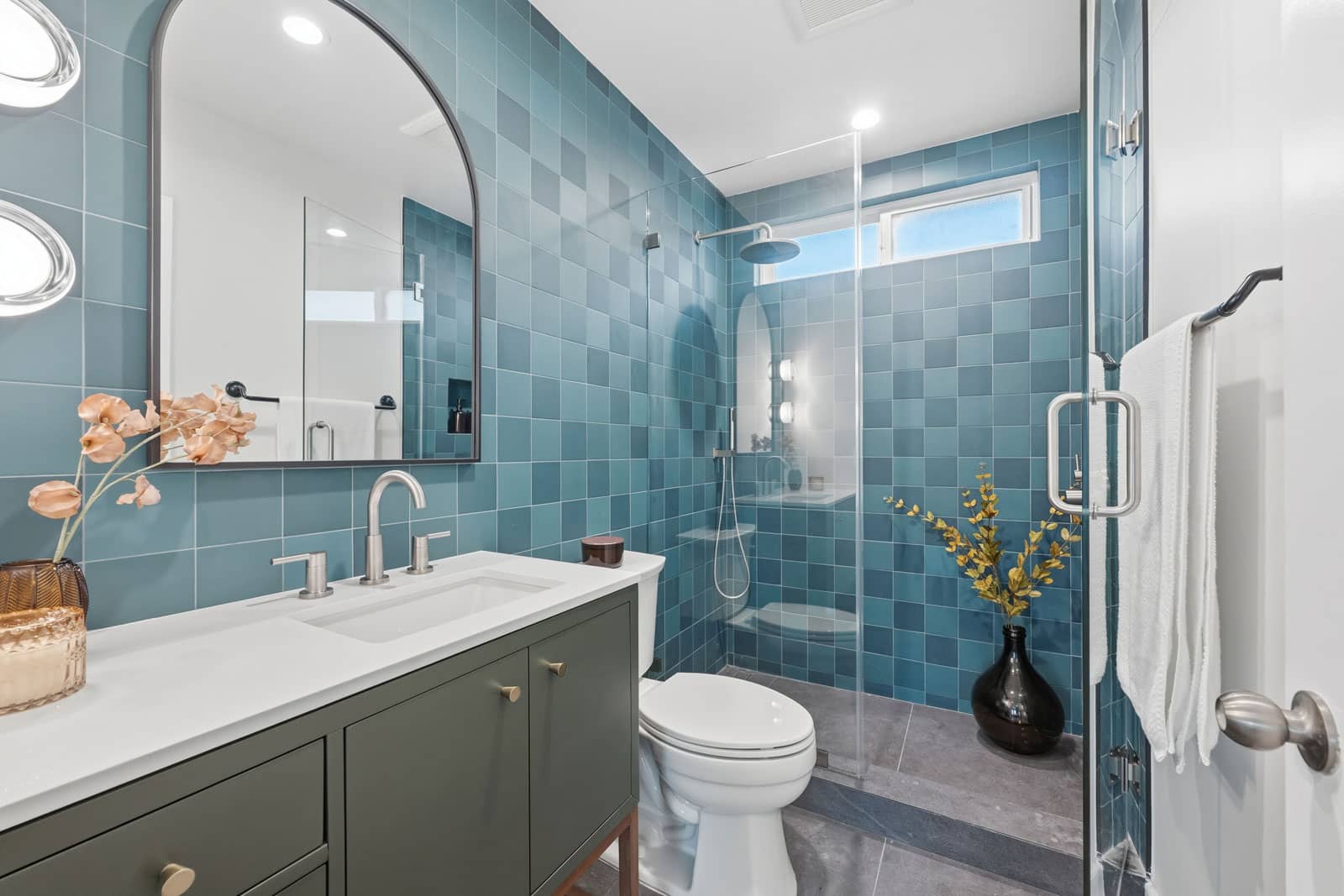
If there’s one detail that instantly signals a contemporary vanity, it’s the slab door – a flat, smooth front with no raised panels, no beveled edges, no grooves. The Shaker door had a great run and still works for transitional spaces, but 2026’s modern bathroom cabinets lean firmly into slab and flat-panel construction. The appeal is simple: a clean front gets out of the way and lets the material shine.
What Makes a Slab Door Feel Modern?
It comes down to how much visual noise the door adds to the room. A flat front adds almost none, and in a small bathroom that quiet is exactly what makes the space feel larger and more spa-like. A few reasons slab fronts keep winning:
- They read calm. No panels or profiles means no visual clutter – a huge advantage in a compact room.
- They’re low-maintenance. No recessed grooves to trap toothpaste, dust, or grime, so a quick wipe keeps them looking new.
- They showcase the surface. A slab door is the perfect canvas for a striking wood grain, a soft matte lacquer, or a textured finish.
- They play well with others. Flat fronts sit comfortably beside natural stone, warm metals, and minimalist hardware without fighting for attention.
The Catch With Slab Fronts
Here’s the honest part: a flat surface hides nothing. Every flaw shows on a slab door – a wavy laminate, a hollow feel, an edge band that lifts within a year. A raised panel can disguise mediocre construction; a slab front puts it on display. That’s why quality of build matters more here than with any other door style. We construct our slab-front vanities on solid plywood boxes with properly bonded, sealed edges, because the whole point of the look falls apart if the details aren’t right.
💡 Mars Brothers Pro Tip: Want the modern slab silhouette but a little warmth? Ask for a rift-cut white oak veneer on a flat door. You keep the disciplined, minimal shape but gain a soft, linear grain – it’s the single most-requested combination we’re building in Orange County right now.
Trend #2 – Warm Woods: White Oak, Walnut, and the Return of Natural Grain
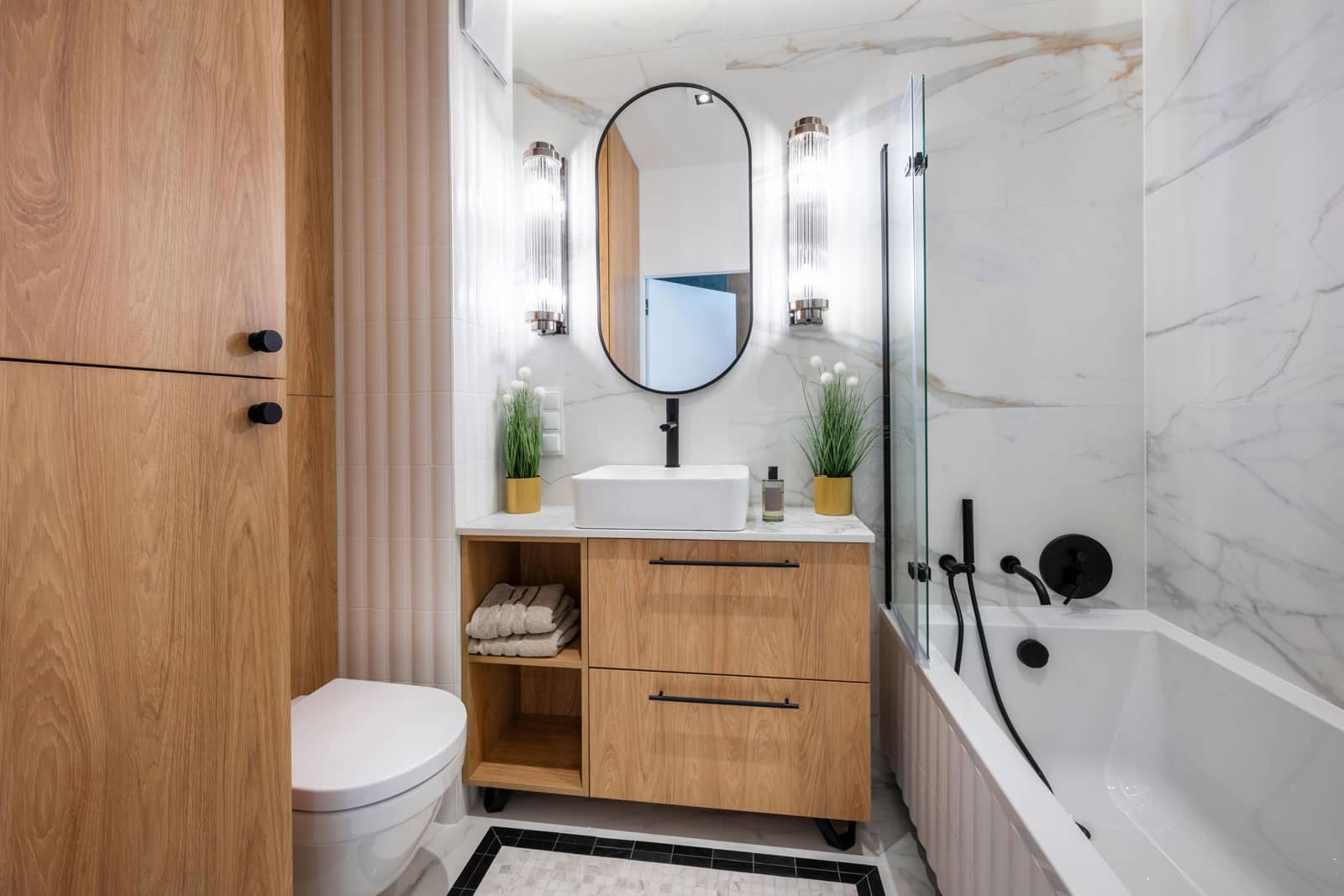
The all-white bathroom is finally warming up. In place of stark lacquer and cool gray, 2026 celebrates real, visible wood grain. White oak leads by a wide margin, walnut brings the drama for darker rooms, and lighter species like maple and ash carry the airy, Scandinavian-leaning spaces. The goal is texture and comfort – a room that feels like a boutique hotel instead of a hospital.
This is one of the trends we champion most, because warm wood ages so gracefully. A wood vanity looks beautiful in soft evening light and forgiving at 7 a.m., and it handles the small chaos of daily life far better than a bright white finish that shows every water spot. When someone tells us they want their bathroom to feel like a retreat, warm-wood modern bathroom cabinets are almost always the answer.
Which Wood Species Works Best?
A few things we’ve learned specifying wood vanities in Southern California:
- Rift-cut or quarter-sawn white oak gives clean, straight grain lines that suit modern design; plain-sawn oak has more swirling “cathedral” pattern – lovely, but busier.
- Walnut delivers instant richness but costs more and gently lightens over time with sun exposure, so plan the placement.
- Engineered veneers over stable substrates often outperform solid wood in a bathroom, because solid lumber can move and warp with humidity swings.
- The finish is as important as the species. A durable, moisture-resistant clear coat protects the grain; a cheap finish clouds and peels.
The Formaldehyde Question Nobody Asks
Here’s a health point most trend articles skip entirely. A lot of wood-look vanities are built on composite wood cores – plywood, MDF, or particleboard – bonded with resins that can release formaldehyde into your indoor air. This is regulated: the U.S. EPA sets national limits under TSCA Title VI, and here in California the rules are stricter and spell it out plainly – the California Air Resources Board’s composite wood program specifically names cabinets and requires compliant products to be labeled. When we source panels for modern bathroom cabinets, we insist on CARB Phase 2 / TSCA Title VI compliant material, because a beautiful vanity shouldn’t compromise the air in a small, enclosed room you use every day.
💡 Mars Brothers Pro Tip: Before you sign anything, ask to see the compliance label on the panels – look for “California 93120 Compliant for Formaldehyde.” When a bid comes in dramatically below the others, uncertified imported board is often the reason. That’s a saving you’ll be breathing for years.
Trend #3 – Hidden Hardware: The Handleless Look
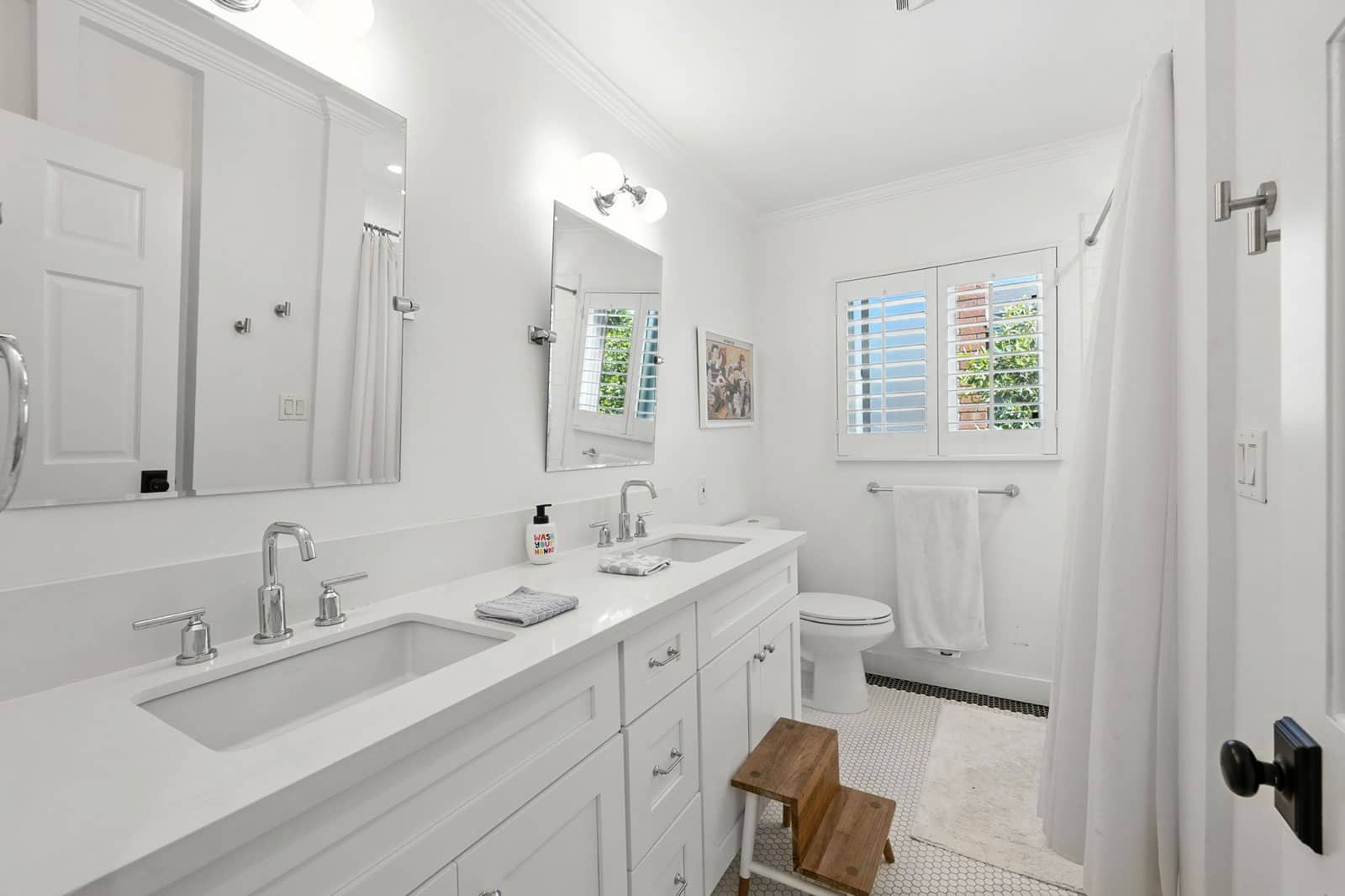
The third defining trend is one you feel more than you see. Hidden, or handleless, hardware removes the visible knob or pull and replaces it with an integrated way to open the door or drawer. The result is a smooth, architectural front that looks less like furniture and more like a seamless wall of built-in cabinetry – precisely the direction modern bathroom cabinets are moving.
Three Ways to Go Handleless
- Push-to-open (touch-latch): a gentle press pops the door or drawer open. The purest minimalist look; best on lower cabinets where eye-level fingerprints aren’t an issue.
- Integrated channel or finger pulls (J-pull): a routed groove or angled edge you grip along the top or side of the door. The handleless look with dependable everyday function.
- Continuous rail pulls: a recessed rail runs behind the top of a drawer bank so the entire front stays flush and clean.
Is Hidden Hardware Practical Day-to-Day?
Genuinely, yes – and in a bathroom it solves real problems. There are no protruding handles to snag a towel or robe, no metal edges collecting mineral buildup, and much less to wipe down. It also frees you from matching hardware finishes across every fixture in the room.
The trade-offs are fingerprints and precision. Push-to-open mechanisms need to be good quality so they don’t sag or stick, matte finishes hide smudges better than gloss, and handleless fronts demand tighter build tolerances – the reveal (the gap between doors) becomes a visible design line instead of something a handle hides.
💡 Mars Brothers Pro Tip: For a busy family bath, mix your methods: push-to-open on the drawers, integrated finger pulls on the doors that get grabbed with wet hands a dozen times a day. A perfectly pure look is great in photos, but a bathroom has to survive real mornings.
The Supporting Trends Worth Knowing
Slab, wood, and handleless hardware are the headliners of modern bathroom cabinets in 2026. These supporting trends round out the 2026 look – mix and match to fit your room and budget.
Floating and Wall-Hung Vanities
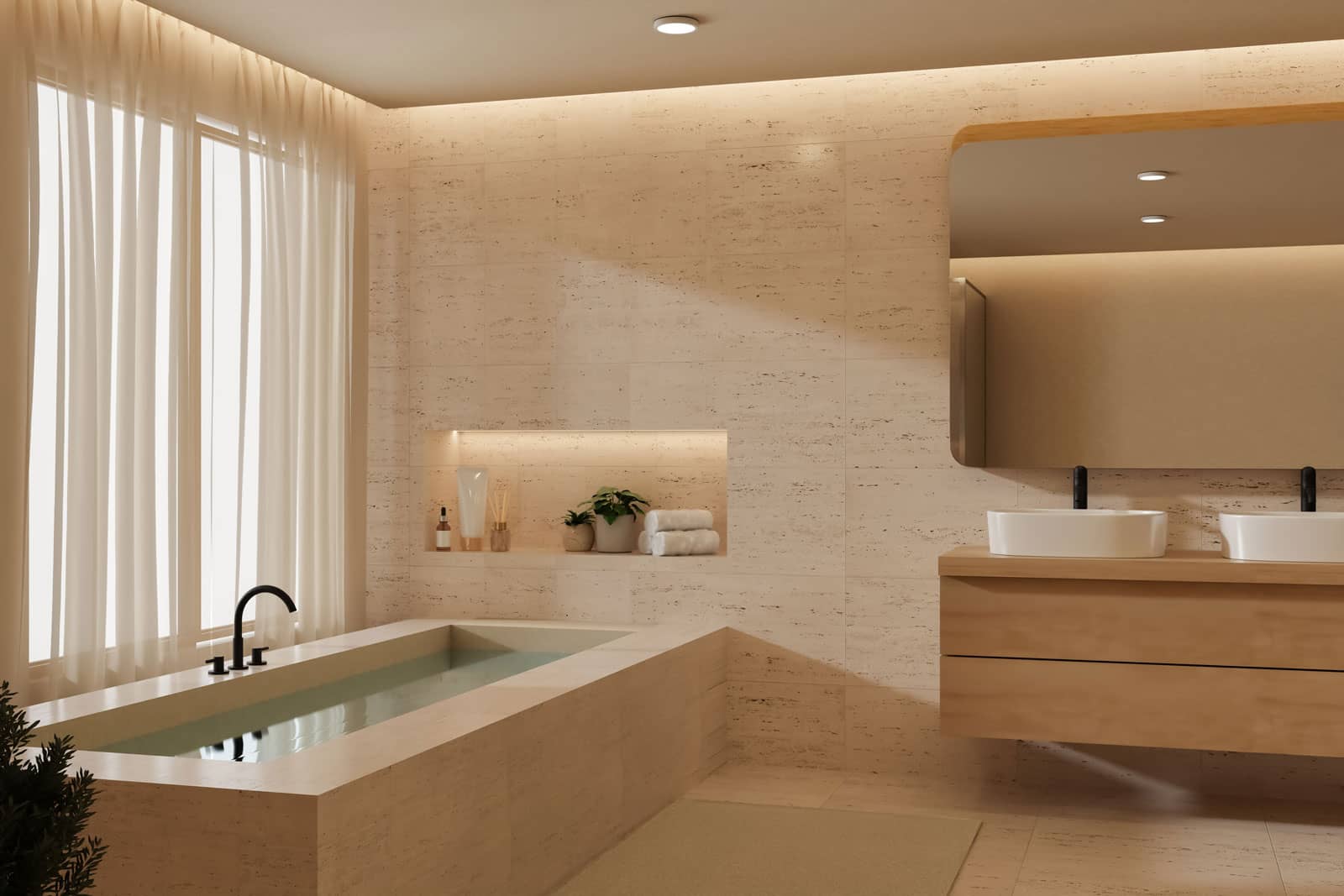
Vanities that float a few inches off the floor remain one of the strongest modern moves, and they’re especially smart in Orange County’s many compact powder rooms. With the floor running continuously underneath, the room feels larger and lighter, and there’s no toe-kick to trap hair and grime. The one requirement is solid in-wall blocking to carry the load – which is exactly the kind of detail we build in during the framing stage of a bathroom remodel rather than bolting on at the end.
Fluted and Reeded Textures
If a totally flat front feels too plain, texture is the 2026 middle ground. Fluted (concave grooves) and reeded (convex ridges) fronts add rhythm and shadow without the fussiness of raised panels. In warm wood or a soft painted finish, a fluted drawer bank reads as custom and considered. Use it as a feature rather than everywhere, or the effect turns busy.
Two-Tone and Mixed Materials
Two-tone designs let you have it both ways – a warm wood main vanity paired with a painted tall cabinet, or a dark base under a lighter floating shelf. Mixing materials (wood with stone, matte paint with a metal accent) adds depth and keeps modern bathroom cabinets from feeling flat. Our rule: choose one hero material and let the second play a supporting role.
Built-In Lighting and Smart Storage
Lighting is moving into the cabinetry itself. Under-vanity LED strips throw a soft floating glow for late-night trips, and lit medicine cabinets bundle storage, mirror, and task light into one clean unit. Inside, 2026 is all about smart storage – drawer-in-drawer organizers, hidden outlets for toothbrushes and razors, and tall pull-outs beside the sink base. Deep drawers are quietly replacing door-and-shelf cabinets everywhere, because you can actually see and reach what’s inside.
Soft Curves and Organic Edges
The hard, boxy corner is softening. Rounded vanity edges, curved-front drawer banks, and gentle arches bring an organic, calming feel that pairs naturally with the warm-wood movement. Subtle, but a curved edge on a floating vanity is the kind of touch that makes a room feel designed instead of assembled.
💡 Mars Brothers Pro Tip: Don’t chase every trend in one bathroom. Our best-looking projects commit to two or three ideas – say, a floating white oak slab vanity with hidden hardware – and stop there. Restraint is what separates a designer bath from a mood board that tried to do everything at once.
Will These Modern Bathroom Cabinets Survive a Humid Bathroom?
A bathroom is the toughest room in the house for cabinetry – steam, splashes, temperature swings, and cleaning chemicals all working against your vanity. Trends are fun, but if the materials are wrong, even the most beautiful modern bathroom cabinets will swell, delaminate, or grow mold within a few years. Here’s what we specify and why:
- Plywood boxes, not particleboard. Quality furniture or marine-grade plywood shrugs off moisture; raw particleboard behaves like a sponge the moment water reaches an edge. This is the most important decision in the whole project and the one homeowners notice the least.
- Sealed edges and solid edge banding. Water attacks the edges first – properly bonded, sealed edges keep a slab front from peeling.
- Moisture-resistant finishes. A durable catalyzed or UV-cured finish handles splashes; a bargain finish clouds and lifts.
- Corrosion-resistant, soft-close hardware. Bathroom humidity is hard on hinges and slides. Quality soft-close mechanisms with proper coatings last; cheap ones seize and squeak.
Ventilation matters as much as the materials. The fastest way to shorten any wood vanity’s life is to trap steam in the room. A properly sized, quiet exhaust fan clears humidity before it settles into the cabinetry – and an ENERGY STAR certified ventilation fan does it efficiently and quietly. We frequently pair a humidity-sensing fan with a warm-wood vanity so the material we chose for its beauty actually gets the chance to age well.
💡 Mars Brothers Pro Tip: After a hot shower, crack the vanity drawers open for a few minutes with the fan running. It sounds fussy, but letting trapped moisture escape is the cheapest thing you can do to protect wood cabinetry over the long haul.
What Do Modern Bathroom Cabinets Cost in Orange County in 2026?
Homeowners deserve real numbers before they call anyone. These are typical installed ranges we’re seeing across Orange County in 2026, with materials, hardware, and labor included. Treat them as ballpark figures – prices flex with size, wood species, and how custom you go – and refresh your expectations each year, since material costs move:
- Stock / off-the-shelf vanity (single sink, ~30–36″): roughly $900–$2,200 installed. Fine for a rental or tight budget, but limited in size, finish, and box quality.
- Semi-custom vanity (single): roughly $2,500–$5,500 installed. The sweet spot for most remodels – real slab or Shaker doors, plywood boxes, soft-close, and genuine finish choices.
- Custom double vanity in warm wood with hidden hardware: roughly $6,000–$12,000+ installed. Rift-cut white oak or walnut, integrated pulls, deep drawers, and floating builds live here.
- Floating / wall-hung upgrade: add roughly $400–$900 for the wall blocking, reinforcement, and precise install a floating vanity requires.
- Built-in LED lighting and smart storage: add roughly $300–$1,500 depending on the number of lit cabinets and pull-out organizers.
Where does the money actually go? Not the door style – that’s mostly aesthetic. When you price modern bathroom cabinets, the real cost drivers are the box material, the wood species, the hardware quality, and the labor a precise handleless install demands. A slab door in laminate and one in walnut can look alike in a photo and differ by thousands in person.
💡 Mars Brothers Pro Tip: On a tight budget, spend on the box and the drawers, not exotic wood. A semi-custom plywood vanity with soft-close drawers and a simple oak-look front will out-function and outlast a “solid wood” bargain vanity built on particleboard every time.
How to Choose the Right Modern Bathroom Cabinets for Your Home
Trends are the starting point, not the decision – the right modern bathroom cabinets are the ones that fit how you actually live. Here’s the short checklist we walk every client through:
- Start with storage, not style. Empty your current vanity onto the counter. Most “not enough storage” complaints are really “wrong storage” – deep drawers usually fix it faster than more doors.
- Match the scale to the room. An oversized vanity swallows a small bath; one set too low wrecks your back. Fit the piece to the space and the people using it.
- Choose the box before the front. The door is what you see; the box is what you live with. Never let a pretty finish distract you from cheap construction underneath.
- Confirm compliance. Ask for CARB Phase 2 / TSCA Title VI labeling on the panels – every time.
- Plan ventilation into the project. The most common cause of ruined cabinetry isn’t a leak; it’s chronic humidity with no fan to clear it.
- Think ten years out. Pick a look you’ll still like when it’s no longer trendy. Warm wood and clean lines age far better than a bold color you’ll tire of.
You can browse door styles and finishes on our cabinet page or see finished rooms in our portfolio to get a feel for how these ideas come together in a real Orange County home.
How We Approach Modern Bathroom Cabinets at Mars Brothers
We’re a family-owned company based in Tustin, serving homeowners across Orange County for nine years and nearly 300 completed remodels. That experience shapes every set of modern bathroom cabinets we build. We start with how you actually use the room – who shares it, what has to fit, what drives you crazy about your current setup – long before we talk door styles.
From there we treat the cabinetry as the anchor of the whole project: the right box material for a humid room, the right hardware for your household, the right proportions for your space, and CARB-compliant panels throughout. We build on plywood boxes and sweat the details that never show up in photos but decide whether your modern bathroom cabinets still look great in a decade. Along the way we’ll give you an honest read on where to spend and where to save – that’s the part homeowners tell us they remember most.
The remodeling process should feel straightforward, not stressful. Clear expectations, dependable scheduling, and craftsmanship we’d put in our own homes: that’s the standard we hold on every project, from a compact powder room to a spa-scale primary bath.
💡 Mars Brothers Pro Tip: Order your vanities before demolition, not during it. Selecting cabinetry while the room is still intact prevents the mid-project scramble – and the rush fees – that blow up so many remodel budgets.
Frequently Asked Questions About Modern Bathroom Cabinets
What are the most popular modern bathroom cabinets styles for 2026?
The three dominant looks are slab (flat-panel) doors, warm natural woods like white oak and walnut, and hidden or handleless hardware. Together they create a clean, spa-like vanity that feels current without being trendy. Supporting trends include floating wall-hung vanities, fluted and reeded textures, two-tone designs, and built-in LED lighting. Most Orange County homeowners combine two or three of these rather than using all of them at once.
Are floating vanities a good choice for a small bathroom?
Yes – a floating vanity is one of the best moves for a small bath. With the floor running continuously beneath it, the room reads larger and lighter, and with no toe-kick there’s nowhere for grime to hide, so cleaning is easier. The one requirement is solid in-wall blocking to support the weight, which is why a floating vanity should be planned during the framing stage of a remodel rather than added later.
What is the best material for modern bathroom cabinets in a humid climate?
Plywood boxes with sealed edges and a moisture-resistant finish outperform particleboard in a humid bathroom, which is why we build our modern bathroom cabinets on quality plywood. Engineered wood veneers over a stable core often handle humidity swings better than solid wood, which can warp. Just as important, pair good materials with proper ventilation – an ENERGY STAR certified exhaust fan removes the steam that damages cabinetry over time.
Is hidden hardware practical for a family bathroom?
It can be, with the right approach. Push-to-open (touch-latch) fronts give the cleanest handleless look but show fingerprints and need a quality mechanism. For busy family baths, we usually mix methods – push-to-open on lower drawers, integrated finger pulls on the doors grabbed with wet hands – so you keep the seamless look without fighting smudges all day. Matte finishes also hide fingerprints far better than gloss.
How much do modern bathroom cabinets cost in Orange County?
In 2026, a semi-custom single vanity typically runs about $2,500–$5,500 installed – the sweet spot for most remodels. Stock vanities start lower, around $900–$2,200, while a custom double vanity in warm wood with hidden hardware can reach $6,000–$12,000 or more. The biggest cost drivers are the box material, the wood species, and hardware quality – not the door style itself. Treat these as ballpark ranges and get a walk-through quote for your specific room.
Ready to Design Your 2026 Bathroom Vanity?
Whether you’re drawn to a floating white oak slab vanity, a dramatic walnut double, or a clean handleless build, the team at Mars Brothers Kitchen & Bath will help you get the details right – from CARB-compliant materials to a precise, long-lasting install. We’ve spent nine years perfecting modern bathroom cabinets for Orange County homeowners, and we’d love to bring that experience to your remodel.