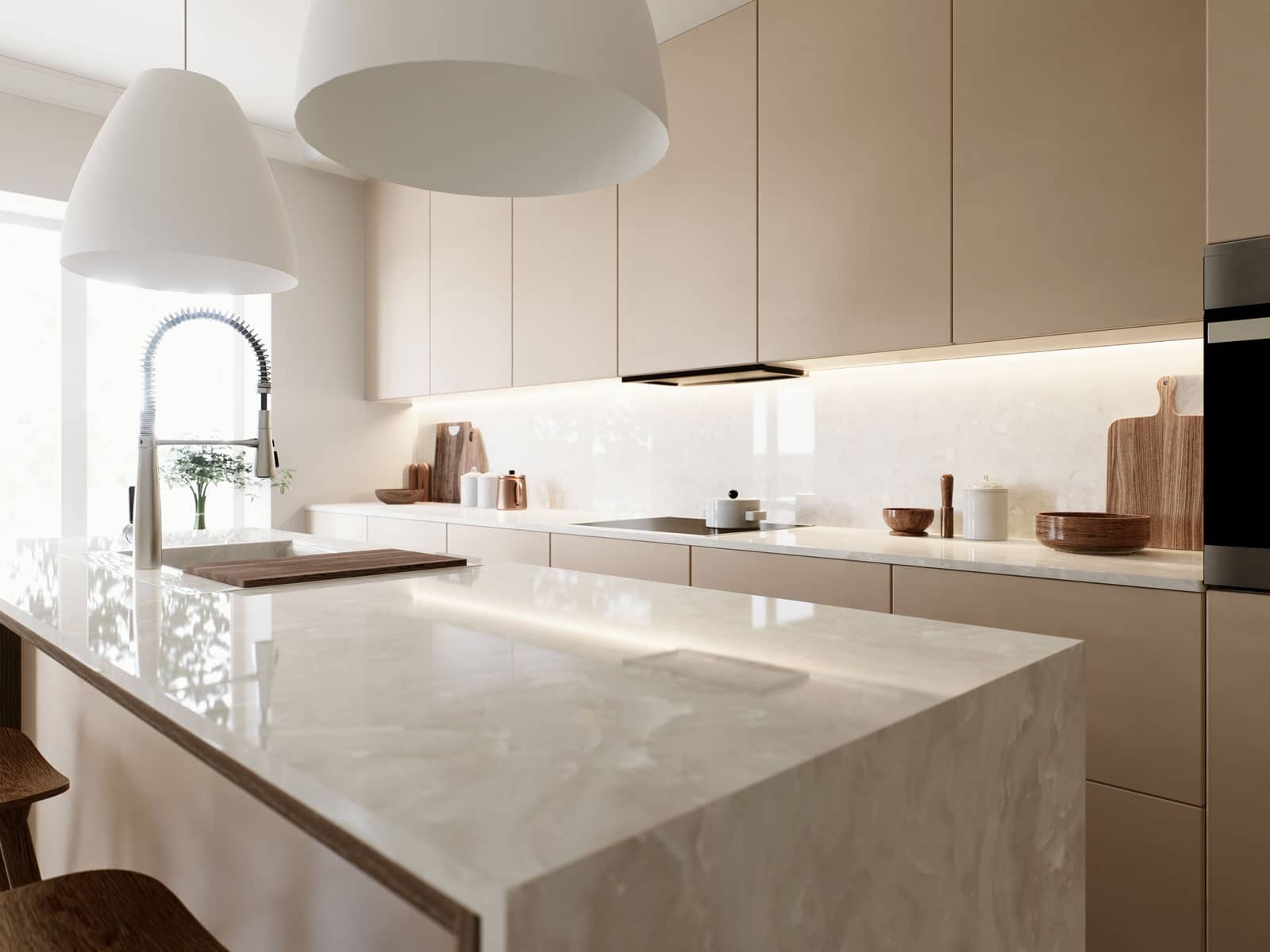
Every kitchen remodel we start in Orange County hits the same fork around week two: granite vs quartz countertops. It’s the decision homeowners agonize over most, and the one where the internet is least helpful – because most of what’s written about granite vs quartz countertops comes from people who have never lifted a slab, never watched a seam cure, and never had to explain to a client why their “indestructible” surface has a scorch ring on it.
At Mars Brothers Kitchen & Bath, we’ve installed both across hundreds of kitchens from Tustin to Dana Point. We have no horse in this race – we sell both. What we have is a clear view of where each side of granite vs quartz countertops actually wins.
So here’s the honest breakdown: 7 key differences between granite vs quartz countertops, with a verdict on each – plus real 2026 Orange County pricing, the safety questions nobody answers straight, and a California regulatory development that should factor into your decision.
Difference #1: How Granite vs Quartz Countertops Are Made
Start here, because half the confusion around granite vs quartz countertops is a naming problem.
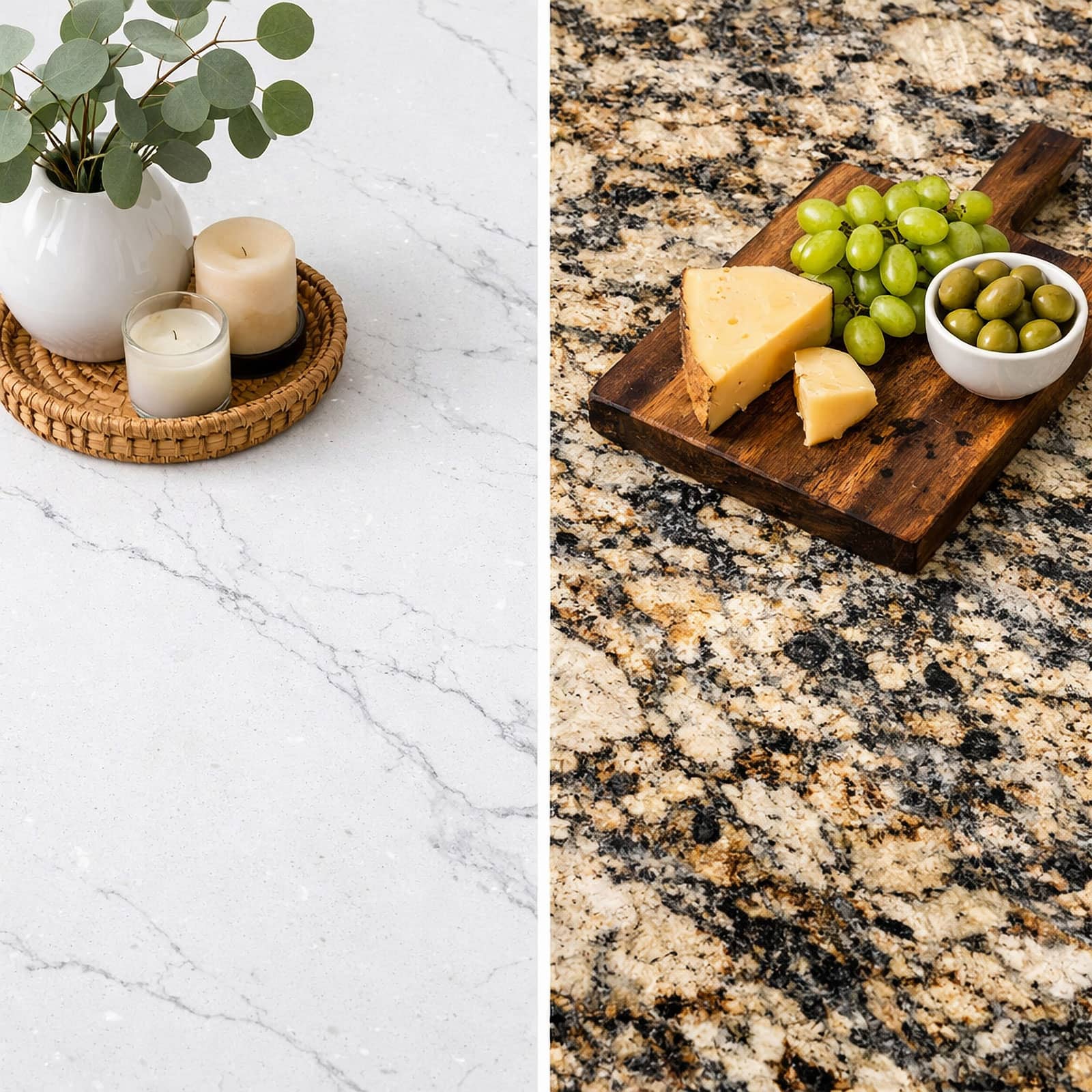
Granite is natural stone – igneous rock formed as magma cooled underground over millions of years, quarried in Brazil, India, and Italy, sawn into 2cm or 3cm slabs and polished. No two slabs match, not even two from the same block.
Quartz countertops are not quartz. They’re engineered stone – roughly 90–93% crushed quartz mineral blended with 7–10% polyester or acrylic resin plus pigments, vibro-compacted under vacuum and cured to a spec. The industry calls it quartz; regulators call it engineered or artificial stone. Slab #4,000 looks like slab #1.
Quarried rock vs manufactured composite. Keep that in mind as we go – it drives every other difference below.
Mars Brothers Pro Tip: When someone tells you quartz is “natural stone,” they’re either confused or selling. It contains natural mineral, but the slab is manufactured. That isn’t a knock – engineering is why quartz wins several rounds of granite vs quartz countertops. But it matters for heat, for UV, and for the regulatory picture below.
Granite vs Quartz Countertops: Which Wins on Origin?
Granite vs quartz countertops verdict: Tie – a real fork, not a cop-out.
Want a surface that’s a piece of the earth? Granite, by default – a manufactured product can’t be a geological original. Want one that behaves predictably and arrives exactly as promised? Quartz. This is the philosophical split in granite vs quartz countertops, and it drives everything below.
Difference #2: How Do Granite vs Quartz Countertops Compare on Looks?
This is where granite vs quartz countertops separates fastest, and where most buyer’s remorse starts.
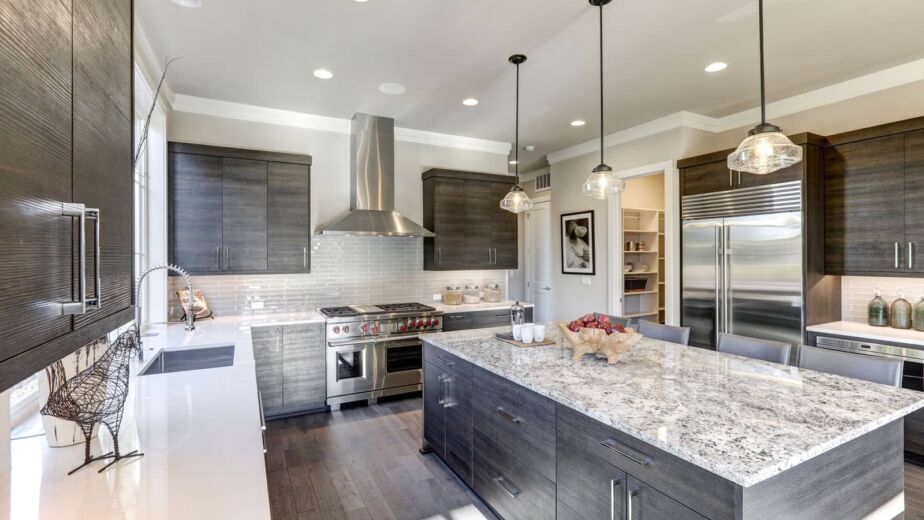
Granite gives you movement, depth, crystals that catch light, and unpredictability. Exotic granites – Blue Bahia, Van Gogh, Fusion – look like abstract paintings because that’s essentially what they are.
Quartz gives you control: a Calacatta look without marble’s fragility, the same veining in the island as the perimeter, a sample you can approve knowing the slab will match.
The honest tradeoff in granite vs quartz countertops:
- Granite’s weakness is the sample problem. The 4-inch chip in the showroom tells you almost nothing about your slab. We’ve watched clients fall for a sample and recoil at the real thing.
- Quartz’s weakness is repetition. Marble-look patterns repeat, and a trained eye catches it on a large island. On a waterfall edge, a careless fabricator can put the same vein in two places – which reads instantly as fake.
Granite vs Quartz Countertops: Which Wins on Looks?
Granite vs quartz countertops verdict: Split – granite for uniqueness, quartz for predictability.
On looks, granite vs quartz countertops comes down to one question: do you want to be surprised? If yes, granite. If a surprise in a $6,000 purchase makes you anxious, quartz. Neither answer is wrong.
Mars Brothers Pro Tip: Never buy granite from a sample. Go to the yard, see your actual slab, put blue tape on it. We do this with every granite client – Orange County has excellent yards within a short drive, and an hour there prevents the most common regret in granite vs quartz countertops.
Difference #3: Heat Resistance – Where Granite vs Quartz Countertops Diverge Most
The difference that surprises people most, and where the marketing around granite vs quartz countertops is most misleading. On heat, granite vs quartz countertops isn’t close.
Granite handles heat. It formed at temperatures that would vaporize your cookware. You can set a hot pan on it. Not as a habit – thermal shock cracks any stone and sealers degrade – but granite tolerates real heat.
Quartz does not. Not because the mineral is fragile, but because the resin binder is plastic, and plastic has a temperature limit – most manufacturers cap it near 300–350°F. A pan straight off a burner clears that easily.
What happens when quartz meets heat:
- Scorching – a permanent yellow or white ring where the resin discolored
- Thermal shock cracking – especially near sink cutouts and cooktop edges, where the slab is already narrow
- Neither is repairable. You can’t sand it out; you replace the section, which usually means the whole run.
Nearly every quartz warranty explicitly excludes heat damage. Read yours.
Granite vs Quartz Countertops: Which Wins on Heat?
Granite vs quartz countertops verdict: Granite, decisively.
The most lopsided category in granite vs quartz countertops. If your household cooks aggressively – pans off the burner, straight to the counter, no trivet in sight – this alone may settle it.
Difference #4: Granite vs Quartz Countertops on Durability, Chips, and Scratches
Flip granite vs quartz countertops from heat to impact and abrasion, and the answer flips with it.
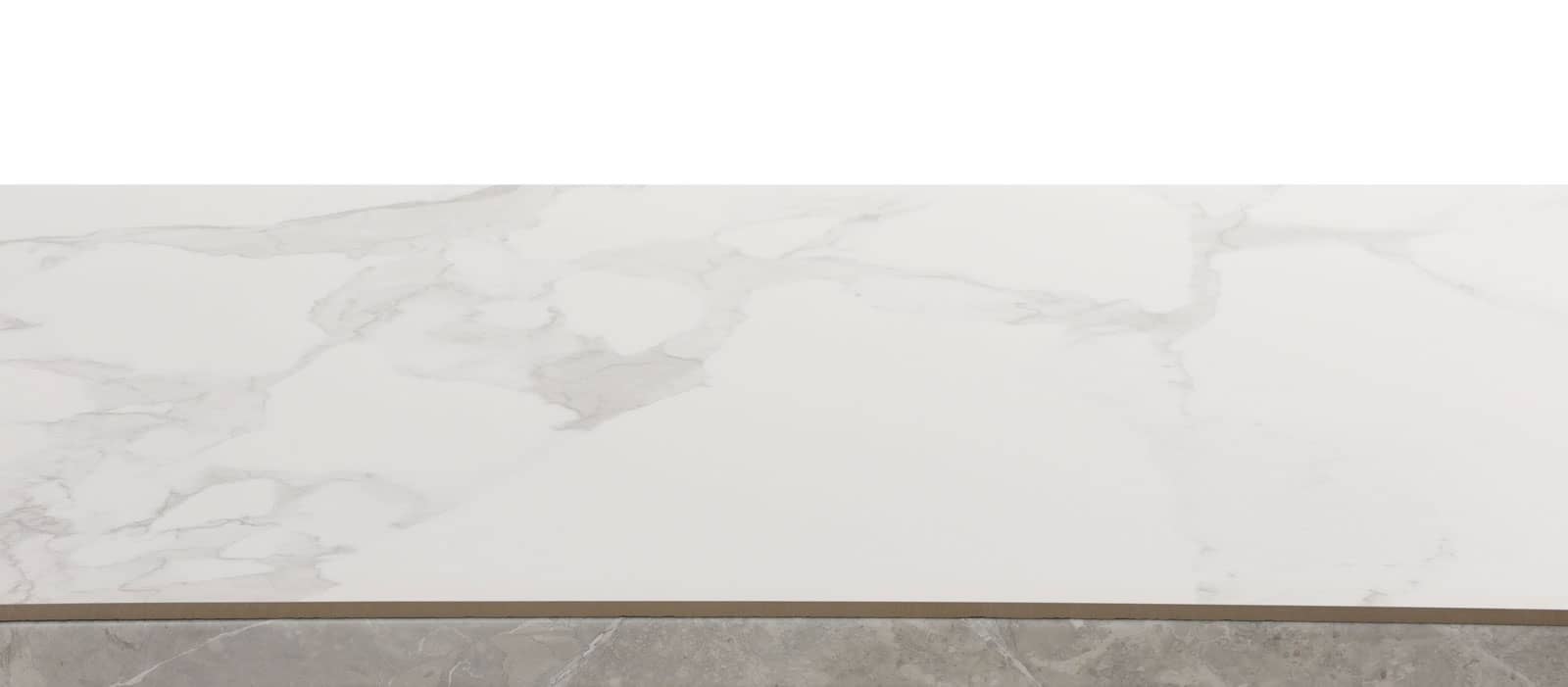
Quartz is harder to damage in daily use. The resin binder that fails at heat gives quartz slight flexibility, so it resists chipping better than granite. It’s also non-porous and highly scratch-resistant.
Granite is hard but brittle. It resists scratches – you’ll dull a knife before you scratch it – but edges and corners chip. Drop a cast iron pan on a granite edge and you’ll find a divot. Chips take color-matched epoxy, and the repair is always visible in the right light.
Where each side of granite vs quartz countertops fails in the real world:
- Granite – chipped edges and sink cutouts, plus fissures mistaken for cracks (a fissure is natural and structural; a crack is not)
- Quartz – heat scorching, UV yellowing (see #7), and edge chips that are harder to hide, since you’re matching pigment and resin rather than stone
Granite vs Quartz Countertops: Which Wins on Durability?
Granite vs quartz countertops verdict: Quartz, on everyday durability.
In a busy family kitchen where the threats are impact and abrasion rather than heat, quartz is the tougher surface. Combine this with #3 and you get the real rule of granite vs quartz countertops: quartz survives your kids, granite survives your cooking.
Difference #5: Granite vs Quartz Countertops Maintenance and Sealing
Of the seven, this is the most lopsided entry in granite vs quartz countertops.
Granite is porous and needs sealing – a penetrating sealer at installation, then every one to three years depending on the stone’s density and how hard the kitchen works. Lighter granites are generally more porous than darker ones. Skip it and granite absorbs oil, wine, and citrus; an oil stain is genuinely hard to pull out.
The water test: drop a tablespoon of water on the granite. If it darkens the stone within 15 minutes, reseal.
Quartz is non-porous. Zero sealing, ever. Soap, water, done. It also doesn’t harbor bacteria in the surface – a real advantage, though let’s be honest: a sealed granite counter that gets wiped down isn’t a public health hazard either.
What quartz still won’t tolerate: abrasive cleansers (they permanently dull the finish), bleach and high-pH cleaners in repeated contact (they degrade resin), and anything with “scouring” on the label.
Granite vs Quartz Countertops: Which Wins on Maintenance?
Granite vs quartz countertops verdict: Quartz, decisively.
On maintenance, granite vs quartz countertops isn’t a debate – quartz asks for nothing. If “one more household chore” is a dealbreaker, this category ends it.
Difference #6: Granite vs Quartz Countertops Cost in Orange County
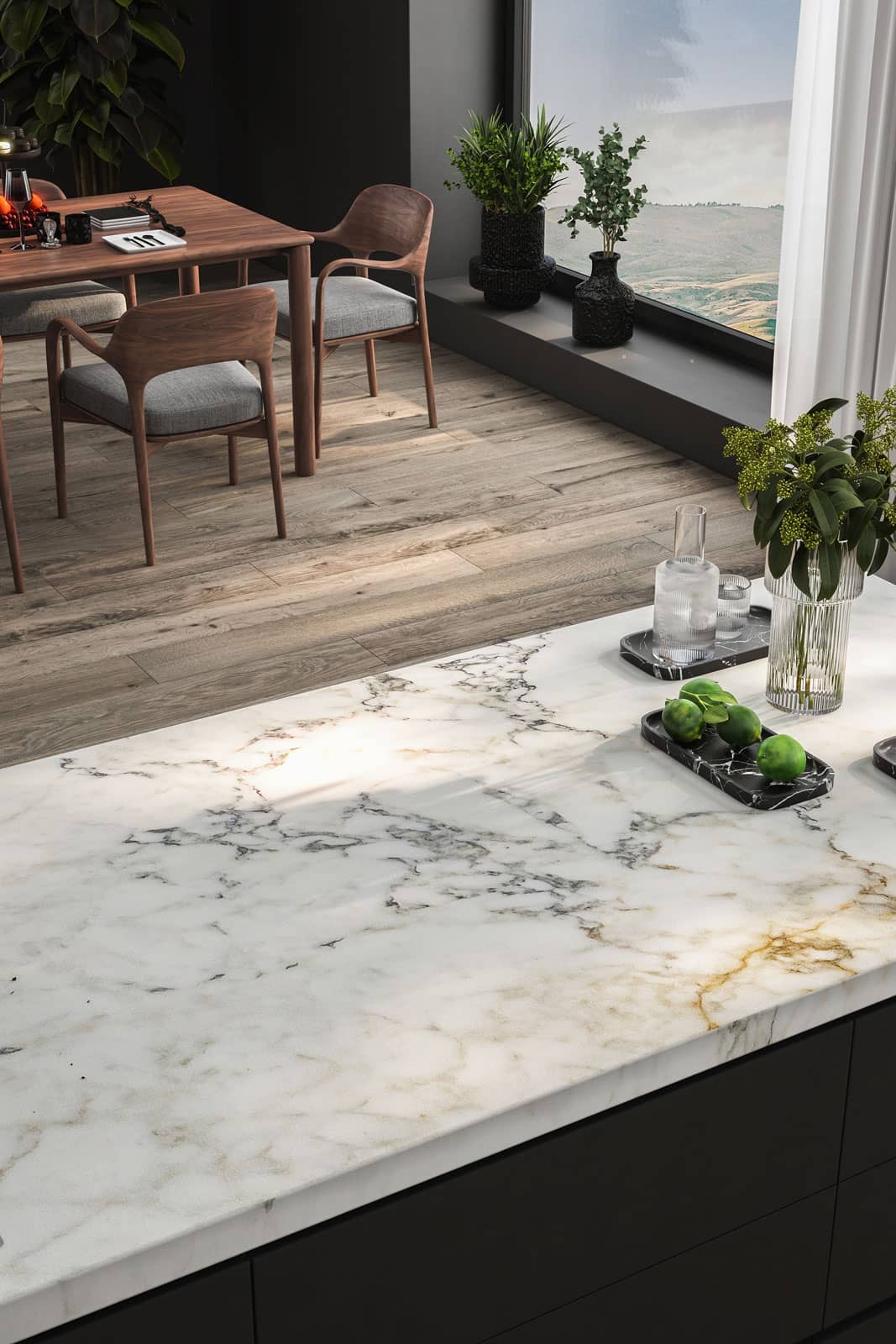
Here’s what we see across our 2026 Orange County projects – observed installed ranges including fabrication, template, and a standard edge, so your project may differ.
Granite, installed per square foot:
- Entry / Level 1: $45–$75 – Uba Tuba, Santa Cecilia, New Caledonia territory
- Mid / Level 2–3: $75–$120 – better movement, better consistency
- Exotic / Level 4+: $120–$275+ – Blue Bahia, Fusion, book-matched material
Quartz, installed per square foot:
- Entry: $60–$90 – basic solids and light speckle
- Mid: $90–$140 – where most Orange County quartz lands; the marble-look programs live here
- Premium: $140–$225+ – high-end veining, thicker slabs, name-brand programs
A typical Orange County kitchen runs 45–60 square feet, which puts granite vs quartz countertops here:
- Granite total: $2,800–$7,000
- Quartz total: $3,800–$8,500
Add-ons that apply to both sides of granite vs quartz countertops:
- Waterfall edge: $900–$2,200 (an extra slab plus a mitered joint)
- Mitered / built-up edge: $30–$70 per linear foot
- Full-height backsplash: $1,200–$3,500
- Sink cutout and polish: $150–$400
Granite vs Quartz Countertops: Which Wins on Price?
Granite vs quartz countertops verdict: Granite, narrowly – at the entry level only.
Entry-level granite is the cheapest real stone in granite vs quartz countertops. But the gap closes fast – mid-tier granite and mid-tier quartz land within a few dollars per square foot, and at the exotic end granite gets far more expensive than quartz ever does.
The bigger point: on granite vs quartz countertops, price rarely decides. The spread on a typical OC kitchen is around $1,000 – roughly 3% of a modest remodel. Choose on performance and looks.
Difference #7: Granite vs Quartz Countertops in Sun and Outdoor Kitchens
This matters more in Orange County than almost anywhere else, and national granite vs quartz countertops comparisons routinely omit it. If you have a patio, it may be the only round that matters.
Granite is UV-stable. It sat in the sun on the surface of the earth before anyone quarried it. It does not care about your patio.
Standard quartz is not UV-stable. The resin binder yellows, fades, and can warp under sustained direct sun, and manufacturers void warranties on outdoor installations. It’s a documented failure mode, and it happens faster in a Newport Beach backyard than in Portland.
If you’re building an outdoor kitchen – and in Orange County many of our clients are – that’s close to disqualifying for standard quartz. Some manufacturers make UV-rated outdoor lines, and porcelain slab is a strong third option, but standard indoor quartz outdoors is a warranty claim waiting to happen.
Watch it indoors too: a west-facing kitchen with a big slider and unshaded afternoon sun can fade quartz over years. We’ve seen it in Laguna Niguel. Rare, but real.
Granite vs Quartz Countertops: Which Wins Outdoors?
Granite vs quartz countertops verdict: Granite, decisively – and it’s not close.
For any outdoor application, granite vs quartz countertops has one answer. Granite. (Or porcelain.)
Granite vs Quartz Countertops: The Scorecard
Seven rounds of granite vs quartz countertops, scored:
Difference | Winner |
1. How they’re made | Tie – philosophical split |
2. Appearance & consistency | Split – Granite for uniqueness, Quartz for predictability |
3. Heat resistance | Granite |
4. Everyday durability | Quartz |
5. Maintenance & sealing | Quartz |
6. Cost (Orange County) | Granite, narrowly, at entry level |
7. UV stability & outdoor use | Granite |
Across the seven rounds of granite vs quartz countertops, granite takes three, quartz takes two, and two are splits. But a scorecard is the wrong way to read granite vs quartz countertops – the categories aren’t equally weighted for you. If you never cook and never go outside, quartz’s two wins outweigh granite’s three. That’s the whole point.
Are Granite or Quartz Countertops Safe? The Two Questions Nobody Answers Straight
Two safety topics come up constantly in granite vs quartz countertops. One is an overblown myth; the other is a serious, current issue most articles ignore. We’ll be straight about both.
Does Granite Emit Radon or Radiation?
Short answer: a non-issue, and the fear is wildly out of proportion to the evidence.
Granite, like any rock, can contain trace radioactive elements that decay into radon. But according to the U.S. Environmental Protection Agency, it’s extremely unlikely that radiation from granite countertops would push your annual dose above normal background levels, and radon from the soil beneath your home is a far larger risk than radon from granite building materials. EPA’s actual recommendation: test every home for radon and mitigate if levels are high – regardless of whether it has granite.
So test for radon because you should test for radon. Not because you chose granite.
The Silica Issue: What Changed for Granite vs Quartz Countertops in California
This one is real, and if you’re weighing granite vs quartz countertops in California right now, you should know about it.
Engineered stone carries an extremely high concentration of crystalline silica – typically over 90%, versus roughly 45–50% for granite. When a slab is cut, ground, or polished, that silica becomes respirable dust, and fabricators who breathe it have developed silicosis, an incurable progressive lung disease, at alarming rates. The CDC’s National Institute for Occupational Safety and Health has documented the outbreak, and California is its epicenter – the state Department of Public Health has confirmed hundreds of cases and dozens of deaths among fabrication workers, most of them young men in small shops.
California has responded harder than any other state. Cal/OSHA issued an emergency temporary standard in December 2023 and a permanent respirable silica standard in January 2025, mandating wet-cutting, respiratory protection, and medical surveillance. Then on May 21, 2026, the state’s Occupational Safety and Health Standards Board voted unanimously to grant a petition directing Cal/OSHA to begin emergency rulemaking that could prohibit fabricating and installing engineered stone containing more than 1% crystalline silica.
Three things to understand about that, in order:
- Your installed countertop is not a health risk to you. Say it plainly: a finished, cured, installed quartz slab is inert. The danger is airborne dust during cutting and polishing – a shop hazard, not a kitchen hazard. Nobody has gotten silicosis from owning a quartz countertop.
- It is not a ban. The May 2026 vote started a rulemaking process, not a prohibition, and advisory committees were convened alongside it. Any actual restriction is months away and may look different from the petition – or may never arrive.
- It is a live variable in a California remodel. Australia banned engineered stone outright in 2024, and IKEA pulled it from its U.S. retail locations. If you’re specifying quartz in California in 2026, the supply and regulatory picture carries more uncertainty than it did two years ago.
What the Silica Rules Mean for Your Granite vs Quartz Countertops Decision
We’re not telling you to avoid quartz. We install it, clients love it, and the material performs. But weighing granite vs quartz countertops in California today, two things belong in the calculus: ask your fabricator directly whether they wet-cut and hold current Cal/OSHA silica compliance – any reputable Orange County shop answers immediately and without defensiveness – and treat this as a rulemaking to watch, not a reason to panic. Because the rules are actively evolving, verify their current state before you specify; mid-2026 may not be where things stand when you read this.
Mars Brothers Pro Tip: That wet-cutting question is the single most useful one you can ask in the whole granite vs quartz countertops process. It tells you about a shop’s ethics, equipment, and attention to detail at once – and those three predict your seam quality better than any showroom ever will.
Which Should You Choose? Granite vs Quartz Countertops by Scenario
Here’s how we settle granite vs quartz countertops with actual clients.
In granite vs quartz countertops, choose granite if:
- You cook seriously and pans hit the counter hot
- You’re building an outdoor kitchen (non-negotiable)
- You want a surface nobody else on earth has
- Your kitchen takes punishing west-facing afternoon sun
- You don’t mind sealing every year or two
Choose quartz if:
- You want a marble look without marble’s problems
- Zero maintenance is a hard requirement
- You want to approve a sample and know what’s coming
- You have kids, and impact worries you more than heat
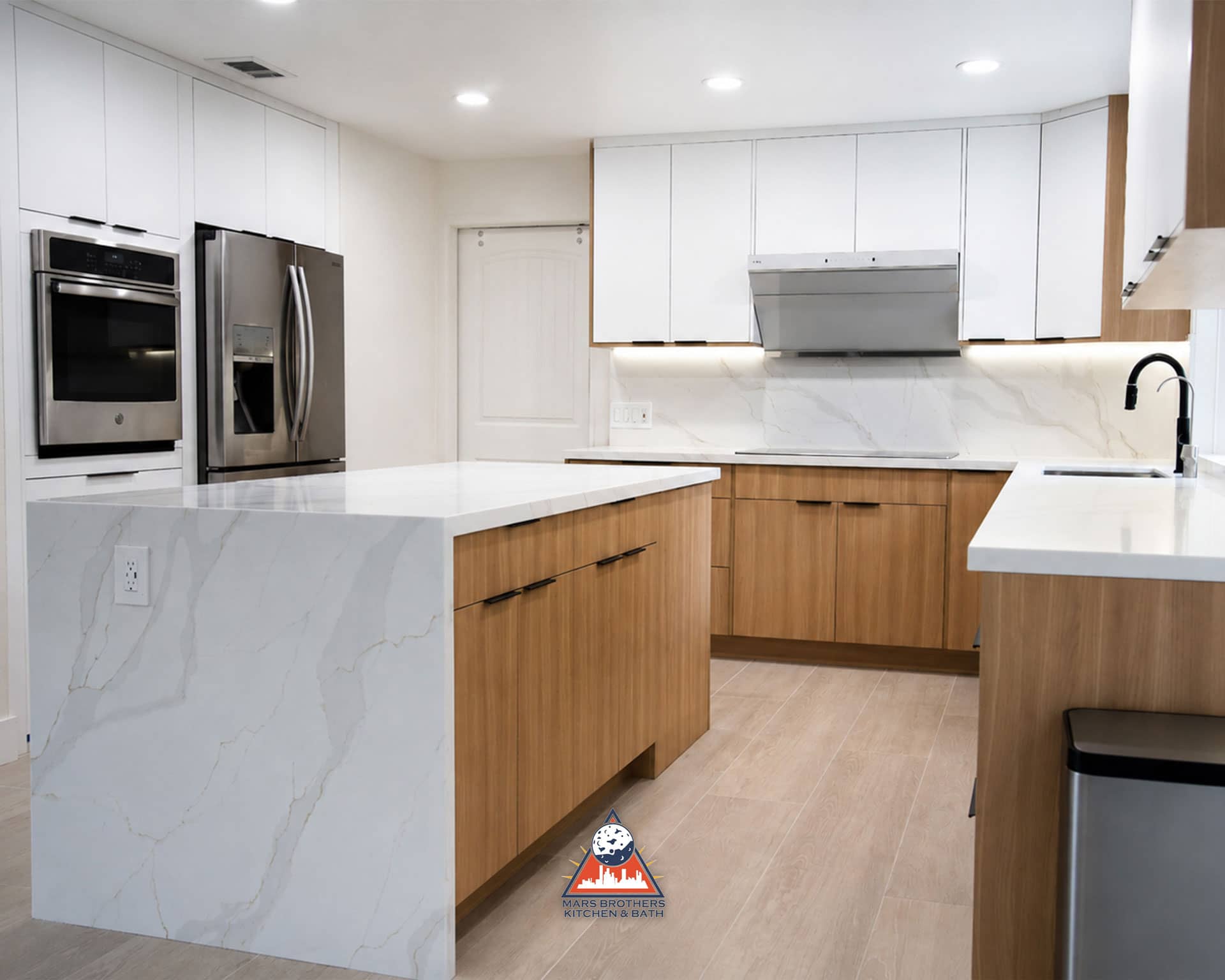
- You’re doing a waterfall island and want vein continuity
A pattern worth knowing: our most common resolution to granite vs quartz countertops isn’t either/or – it’s both. Quartz on the perimeter where the work and the kids happen, granite or an exotic natural stone on the island where the eye lands. You get quartz’s maintenance profile where you need it and a one-of-a-kind slab where it shows. In Orange County kitchens with a big island, that’s what we recommend more often than not.
What Do Most People Get Wrong About Granite vs Quartz Countertops?
- Believing quartz is heatproof. The #1 misconception in granite vs quartz countertops, and an expensive one.
- Buying granite from a 4-inch sample. See your slab. Tape your slab.
- Assuming granite is high-maintenance drudgery. It’s a 20-minute job every year or two.
- Thinking price will decide it. It won’t. The spread on granite vs quartz countertops is about $1,000 on a typical kitchen.
- Ignoring the seam plan. Where seams land matters more than the material. A great fabricator with granite beats a careless one with premium quartz, every time.
- Not asking about the fabrication shop. See the silica section. Ask the question.
Frequently Asked Questions About Granite vs Quartz Countertops
Which is more expensive, granite or quartz countertops?
At the entry level granite is cheaper – roughly $45–$75 per square foot installed in Orange County versus $60–$90 for basic quartz. But the ranges overlap heavily in the middle, and at the high end granite gets far more expensive than quartz ever does, with exotic slabs at $275+ per square foot. For a typical 45–60 square foot OC kitchen, expect $2,800–$7,000 for granite and $3,800–$8,500 for quartz. That spread is small enough that price should rarely decide granite vs quartz countertops.
Do quartz countertops really scorch from hot pans?
Yes – and it’s the most important thing to understand about quartz. The slab is bound with polymer resin, and most manufacturers cap heat tolerance near 300–350°F, well below a pan straight off a burner. Damage shows up as permanent yellow or white scorching, or thermal shock cracks near sink and cooktop cutouts. It isn’t repairable and it’s excluded from virtually every warranty. Granite tolerates real heat. In granite vs quartz countertops, this is granite’s most decisive win.
How often do granite countertops need to be sealed?
Every one to three years for most granite, depending on density and how hard your kitchen works – lighter, more porous granites need it more often than dense dark ones. The test: put a tablespoon of water on the surface and wait 15 minutes; if the stone darkens, reseal. The job takes about 20 minutes with a bottle of penetrating sealer. Quartz never needs sealing at all – its clearest win in granite vs quartz countertops.
Are quartz countertops being banned in California?
Not currently. On May 21, 2026, California’s Occupational Safety and Health Standards Board voted to begin emergency rulemaking that could eventually prohibit fabricating and installing engineered stone containing more than 1% crystalline silica – but that’s the start of a process, not a ban, with advisory committees reviewing it in parallel. The concern is occupational: silica dust generated when workers cut and polish slabs, which has caused hundreds of silicosis cases among California fabricators. An installed quartz countertop in your kitchen poses no such risk. Because this is actively developing, check the current status before you specify.
Can you put quartz countertops outside in Orange County?
Standard quartz, no. The resin binder isn’t UV-stable, so direct sun causes yellowing, fading, and warping – and virtually every manufacturer voids the warranty outdoors. That matters in Orange County, where outdoor kitchens are common and the sun is relentless. Granite is fully UV-stable and is the right natural-stone answer outside; porcelain slab is an excellent alternative. A few manufacturers offer UV-rated outdoor quartz lines, so ask specifically. For outdoor use, granite vs quartz countertops isn’t really a debate.
Still Deciding Between Granite vs Quartz Countertops?
Granite vs quartz countertops has no universal answer – it has your answer. It depends on how you cook, how much sun your kitchen takes, whether there’s an island, whether there’s a patio, and how you feel about a bottle of sealer once a year. That’s a conversation, not an article – and it’s one we have every week.
Mars Brothers Kitchen & Bath is a family-owned remodeling contractor based in Tustin, serving Irvine, Newport Beach, Dana Point, Laguna Niguel, and the greater Orange County area – kitchen remodels, bathroom renovations, custom closets, and flooring. We install both sides of granite vs quartz countertops, we’ll walk the slab yard with you, and we’ll tell you honestly when the material you’re drawn to is wrong for how you live.
Bring us your layout and how you actually cook. We’ll settle granite vs quartz countertops for your kitchen in about fifteen minutes.