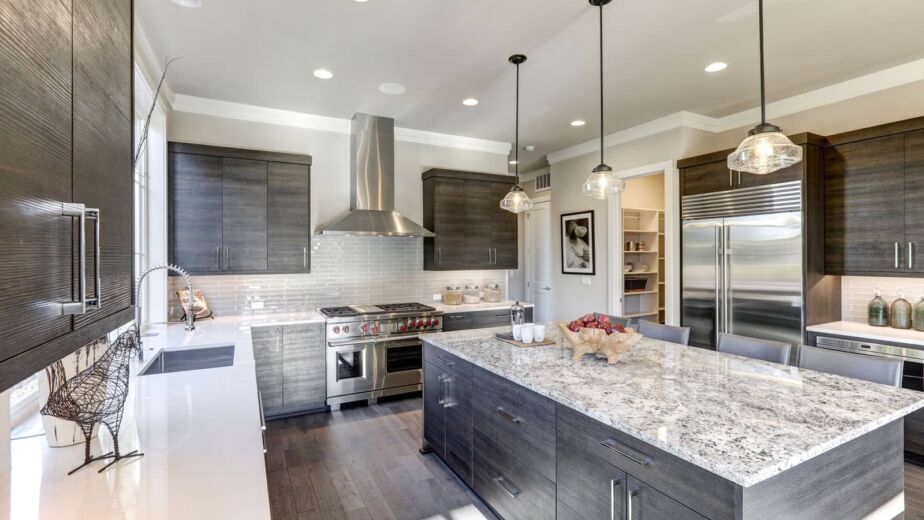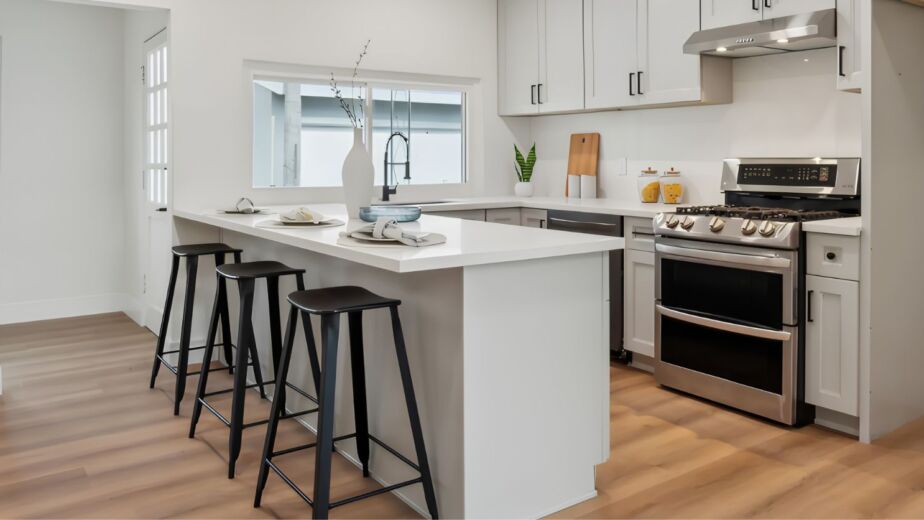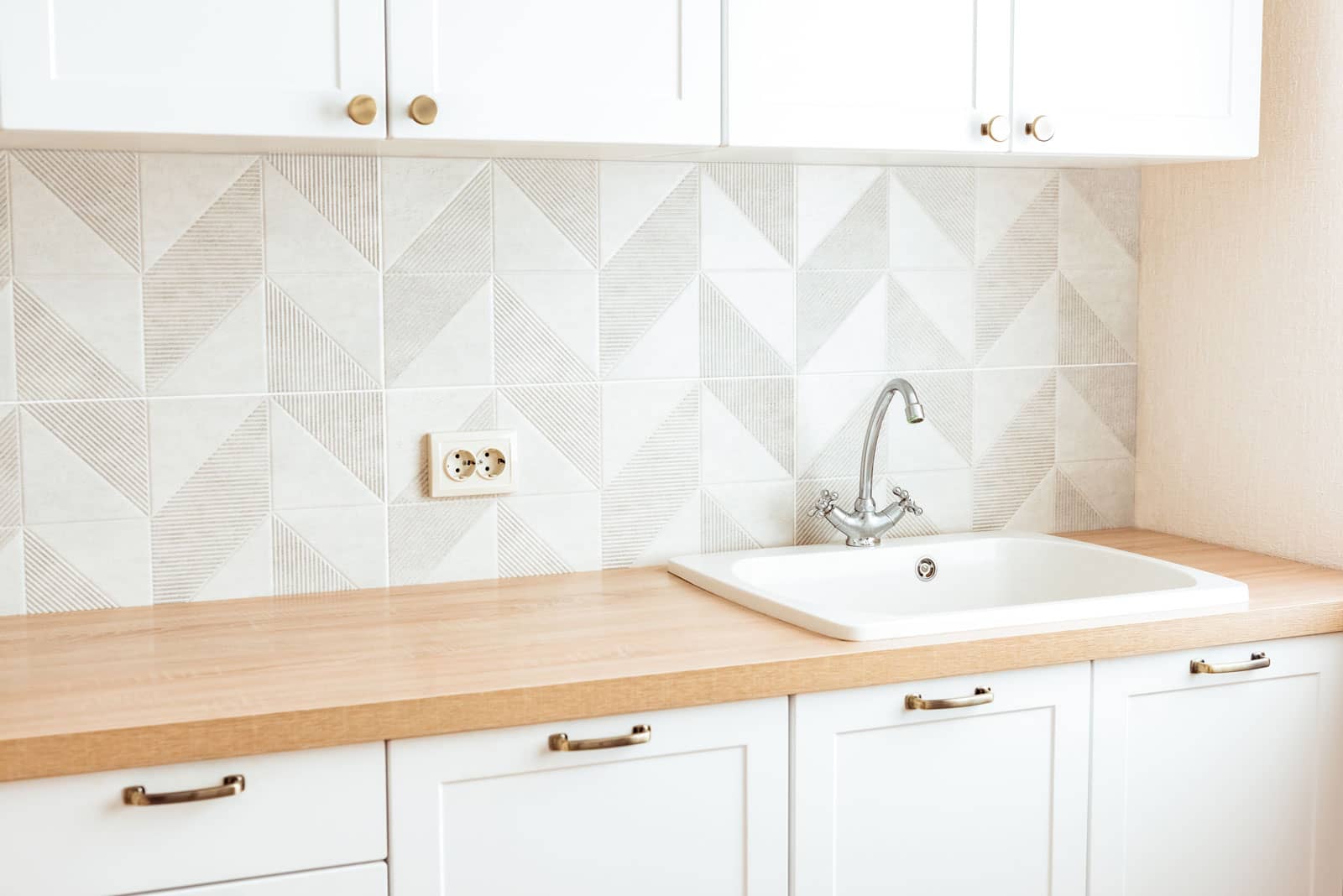
Walk into a hundred Orange County kitchens and you’ll see the same thing: a beautiful island, a gorgeous slab, custom cabinetry- and kitchen island lighting that was clearly an afterthought. Two undersized pendants hung too high, aimed nowhere in particular, wired to a switch that only knows “blast” or “off.”
At Mars Brothers Kitchen & Bath, we’ve remodeled kitchens from Tustin to Dana Point, and we’ll say this plainly: kitchen island lighting is the highest-leverage decision in the room. It hangs at seated eye level. It’s the only element asked to be a sculpture and a work light at once. When it’s wrong, no amount of quartzite rescues it.
This guide covers how we approach kitchen island lighting across the three styles we build most often in Orange County- modern, coastal, and transitional. Real hanging heights, real spacing math, real local pricing, and the California code requirements that trip up most homeowners.
Why Does Kitchen Island Lighting Matter More Than Any Other Fixture?
Every other light in a kitchen does one job. Recessed cans wash the floor. Undercabinet strips light the counters. Kitchen island lighting is the only fixture asked to do four jobs at once:
- Task lighting. The island is where chopping, prep, and homework happen. It needs real, usable light.
- Architectural focal point. Kitchen island lighting hangs at eye level in an open floor plan- visible from the family room, the dining area, often the entry.
- Style declaration. The fixtures announce whether a kitchen is modern, coastal, or transitional before anyone notices the cabinet profile.
- Mood control. The same kitchen island lighting handles a 7 a.m. school-lunch scramble and a 9 p.m. glass of wine.
Mars Brothers Pro Tip: Select your kitchen island lighting before the electrical rough-in walkthrough, not after drywall. Reworking a ceiling junction box once drywall is up adds patch, texture, and paint to a job that should have taken twenty minutes.
How High Should Kitchen Island Lighting Hang Above the Countertop?
The working rule: 30 to 36 inches from the countertop to the bottom of the fixture.
- 30–32 inches– Best for large drum shades or any fixture with visual mass. Hanging lower keeps a big shade from dominating the sightline.
- 32–34 inches– The comfortable default for most kitchen island lighting under an 8- to 9-foot ceiling. Where we land on the majority of our projects.
- 34–36 inches– Right for small glass globes and slim cones you want to read as delicate rather than dominant.
How Do Ceiling Heights Change the Kitchen Island Lighting Math?
Orange County housing stock is wildly inconsistent on ceiling height, and kitchen island lighting has to adapt.
- 8-foot ceilings (a lot of 1960s–70s Tustin and Santa Ana tract homes): Stay at 32–34 inches and keep the fixture profile compact. Tall cylinders eat headroom fast.
- 9- to 10-foot ceilings (most newer Irvine construction): Room to breathe. Kitchen island lighting can carry more vertical presence- elongated cones, tiered shades, longer stems.
- Vaulted or two-story ceilings (common in Newport Coast and Laguna Niguel): Do not scale the drop to the ceiling. Scale it to the island. Kitchen island lighting still lands 30–36 inches above the counter no matter how far the ceiling is above it. What changes is stem length and visual weight- a pendant that reads correctly at 8 feet disappears under a 20-foot vault.
A test we run on every job: sit at the island, then stand across the great room. If the fixture blocks the view of the person opposite you, it hangs too low- whatever the tape says. Open-concept homes changed the rules. Kitchen island lighting used to be judged from inside the kitchen; now it’s judged from the sofa, twenty feet away.
How Do You Choose Kitchen Island Lighting for a Modern Kitchen?
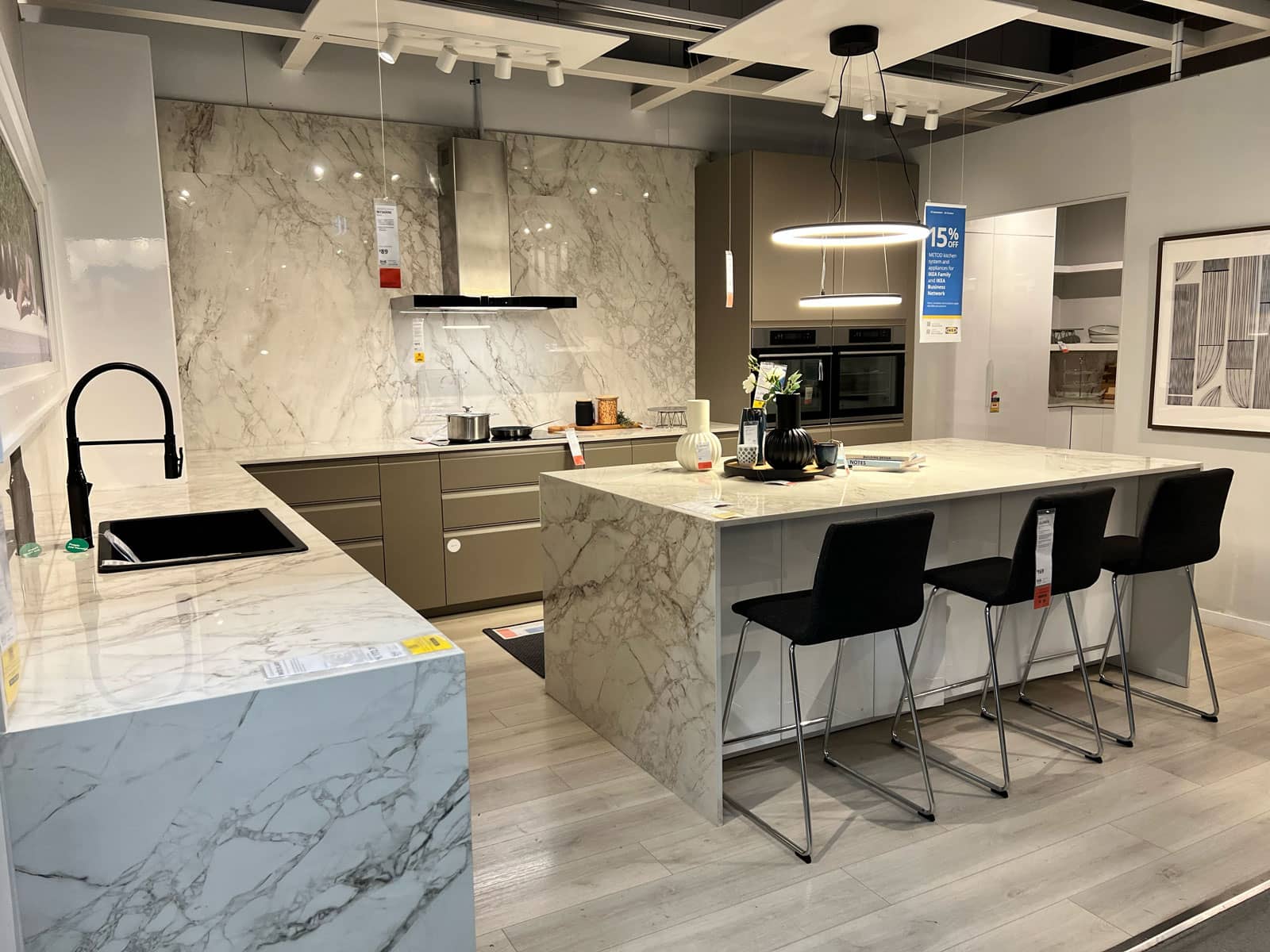
Modern kitchens run on restraint- flat-slab doors, integrated pulls, waterfall edges, one continuous material story. Kitchen island lighting here has one rule: do not add noise.
What Fixture Shapes Read as Modern?
- Linear suspension bars. A single horizontal element, often 36″ to 60″. Our most-requested modern kitchen island lighting. It echoes the island’s rectangle instead of fighting it.
- Cylinder and tube pendants. Simple extruded forms, no shade detail, usually matte black or brushed brass.
- Disc and halo pendants. Thin illuminated circles. Almost jewelry, and beautiful over a waterfall island.
- Cone pendants. The quiet workhorse- clean geometry, directional light, works at any budget tier.
Avoid visible filament drama, cage work, or farmhouse-Edison energy. Modern kitchen island lighting fails when it tries to be a conversation piece.
Which Finishes Work for Modern Kitchen Island Lighting?
- Matte black– the safest high-contrast choice against white oak or pale quartz
- Brushed or unlacquered brass– warms up a cool palette; expect (and want) patina
- Smoked or fumé glass– our favorite move when a client wants warmth without color
Should Modern Kitchens Use One Linear Fixture or Multiple Pendants?
Both are correct. Choose a single linear fixture when the island is under 8 feet, the ceiling is flat, and you want minimal visual interruption- it’s also the easier install, one box and one drop. Choose multiple pendants when the island exceeds 8 feet, when vaulted geometry needs rhythm, or when you’re seating four-plus stools. Pendants also age better in resale terms; a linear bar is a commitment to a moment.
Mars Brothers Pro Tip: On a linear kitchen island lighting install, always specify a canopy that can be field-adjusted for level. Ceilings in older Orange County homes are never dead flat, and a 60-inch bar shows a quarter-inch of slope from across the room.
What Makes Coastal Kitchen Island Lighting Different?
Coastal is the most misunderstood category we work in. Homeowners in Newport Beach, Corona del Mar, and Dana Point don’t want nautical– they want airy. The difference between good coastal kitchen island lighting and a themed restaurant is roughly one rope detail.
What Materials Define Coastal Kitchen Island Lighting?
- Woven natural fiber– rattan, seagrass, abaca, jute. The defining coastal move; the shadows a woven shade throws are the entire point.
- Clear or seeded glass– schoolhouse globes, bell jars, hand-blown shapes. Coastal kitchen island lighting leans on transparency because coastal kitchens lean on daylight.
- Whitewashed and driftwood-toned wood– especially in coastal-transitional hybrids.
- Aged brass and weathered zinc– finishes that already look like they’ve lived near salt air.
- Milk glass– soft and forgiving in a room with heavy window glare.
Does Salt Air Actually Affect Kitchen Island Lighting?
Less than people fear inside a conditioned kitchen- but it isn’t zero, and we’ve replaced enough hardware in Dana Point and Laguna Beach to take it seriously. Homes within about a mile of the water, especially those that live with windows open, see accelerated corrosion on unprotected metals. For coastal kitchen island lighting near the water:
- Favor solid brass over brass-plated steel. Plating fails at the edges first, and once it fails it looks cheap.
- Powder-coated finishes outperform painted finishes considerably.
- Unlacquered brass is a genuine advantage- salt air accelerates an outcome you already wanted.
- Be skeptical of chrome in a beach-adjacent kitchen. It pits, and pitted chrome has no charm.
How Do You Keep Coastal Kitchen Island Lighting From Looking Themed?
The rule we give clients: one coastal gesture per fixture, maximum. A rattan shade is coastal. A rattan shade with rope wrapping and a ship’s-wheel cage is a gift shop. The most successful coastal kitchen island lighting we install is usually the quietest- three seeded-glass globes over a white oak island, and the room does the talking.
What Does Transitional Kitchen Island Lighting Look Like?
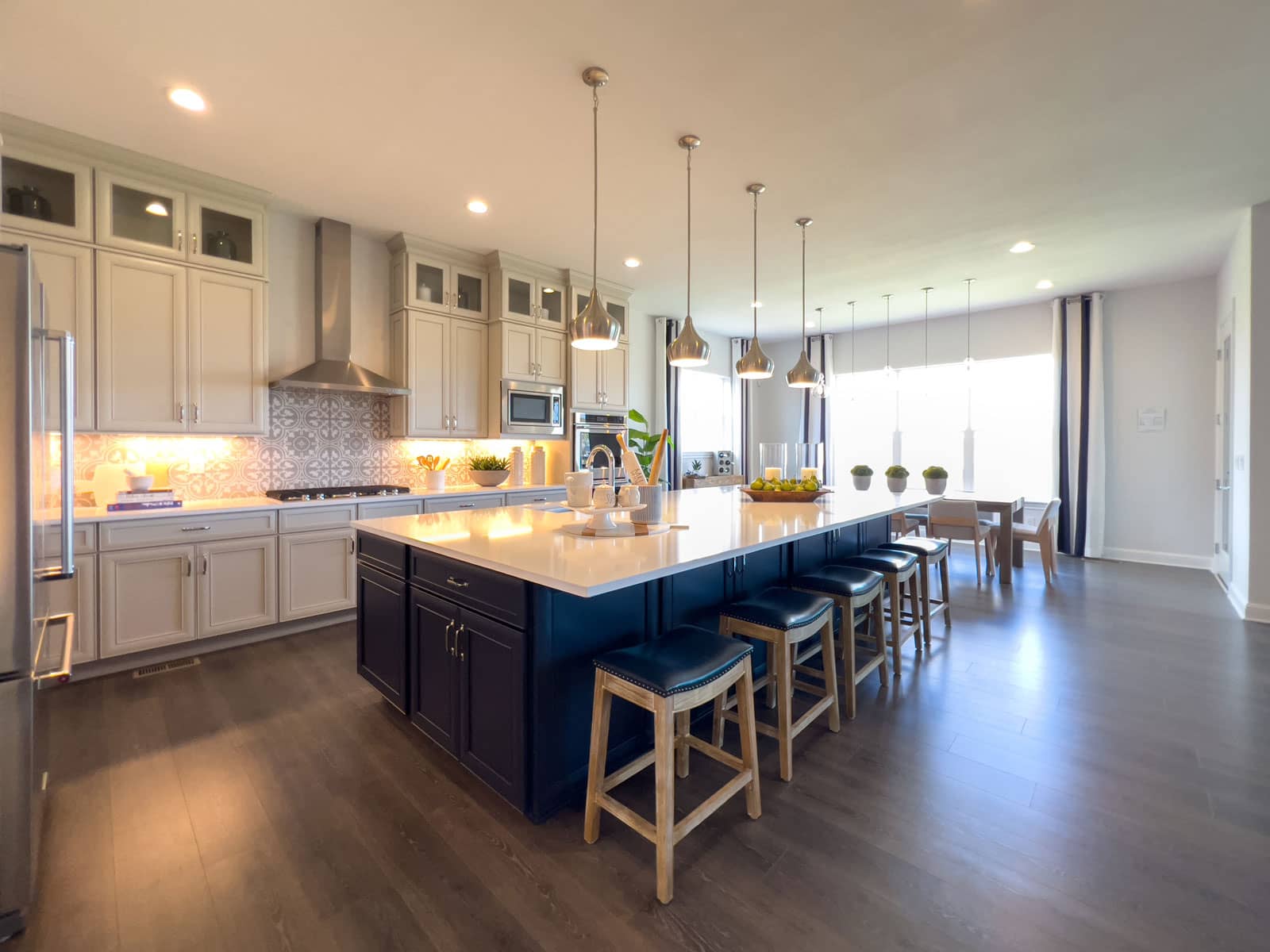
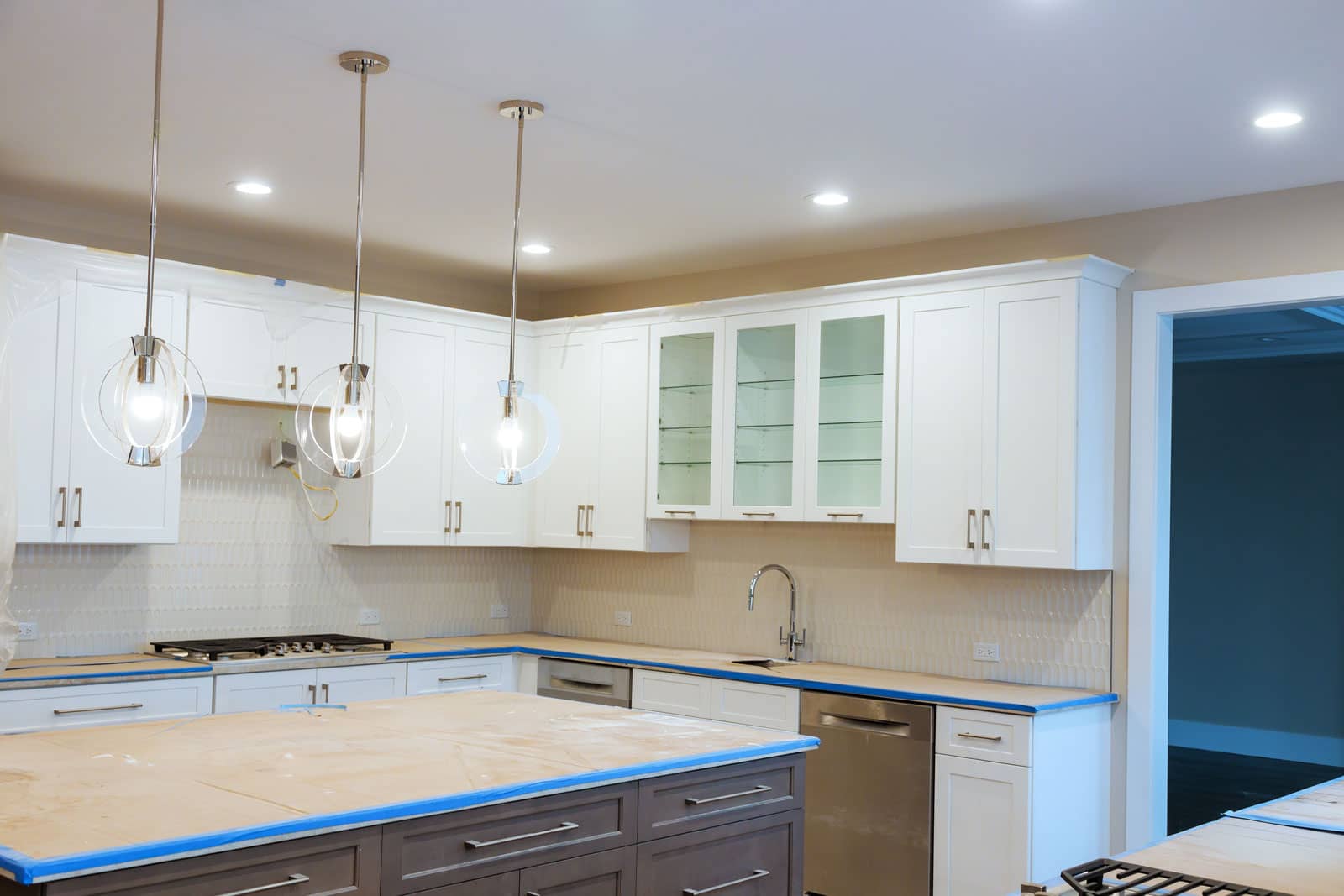
Transitional is the largest category in Orange County by a wide margin: shaker doors with modern pulls, white perimeters with stained islands, traditional bones with the ornamentation stripped out. Transitional kitchen island lighting lives in that same space:
- Lantern pendants– a traditional silhouette in a clean frame. The definitive transitional fixture.
- Metal-and-glass shades– traditional shape, modern material honesty.
- Simple drum pendants– fabric or metal, no trim, no fuss.
- Slim schoolhouse globes– reads either direction depending on finish.
What Finishes Work Best for Transitional Kitchen Island Lighting?
Mixed metals aren’t just permitted here- they’re the point:
- Polished nickel kitchen island lighting with matte black cabinet hardware
- Aged brass pendants with polished chrome faucets
- Matte black lanterns with unlacquered brass pulls
The trick is a rule, not a vibe: pick two metals and repeat each at least twice in the room. Brass kitchen island lighting plus a brass faucet plus brass sconces reads intentional. One lonely brass fixture reads like a mistake.
Mars Brothers Pro Tip: We mock up kitchen island lighting finishes against the actual slab sample under the actual bulb temperature the client chose- not showroom fluorescents. Aged brass against Calacatta Gold at 2700K is a completely different color than the same fixture on a showroom wall at 4000K.
How Many Pendants Should Hang Over a Kitchen Island?
Simpler than people expect. Here’s the framework we use on every project.
Step 1- Count by island length:
- Under 5 feet: one pendant, centered
- 5 to 7 feet: two pendants
- 7 to 9 feet: two large pendants or three small ones
- 9 feet and over: three pendants, or a linear fixture
Step 2- Size the fixture. Divide island length in inches by 3 to find each pendant’s zone. A 72-inch island gives you roughly 24 inches per zone, which supports an 8- to 14-inch diameter pendant depending on how much air you want.
Step 3- Space them. Keep at least 6 inches (12 is better) from fixture edge to island edge, and set pendant centers 24 to 30 inches apart.
Step 4- Sanity-check the stools. Kitchen island lighting should never land on a seated head. If pendant centers don’t align with the gaps between stools, fix the plan before the boxes get set.
Is Odd-Numbered Kitchen Island Lighting Always Better?
“Always use odd numbers” is a rule of thumb, not physics. Odd counts create a natural center, which helps when the sink or cooktop sits centered. But two oversized pendants over a 7-foot island is one of the most elegant kitchen island lighting solutions there is. Let island length and fixture scale decide- not superstition.
What Bulbs, Color Temperature, and Dimming Should Kitchen Island Lighting Use?
This is where most kitchen island lighting projects quietly fail. The fixtures are beautiful; the light is terrible.
What Color Temperature Is Right?
- 2700K– warm and flattering. Our default for coastal and transitional kitchen island lighting.
- 3000K– slightly crisper. Our default for modern kitchens with cool-toned quartz, and a better match for white marble, which goes yellow-gray at 2700K.
- 3500K and above– almost always wrong in a home. It’s showroom light. Food looks unappetizing, skin looks tired.
Whatever you choose, every bulb in the room must match. Mixed color temperature is the most common lighting error we correct, and the reason a kitchen can feel “off” for years without anyone identifying why.
Why Does CRI Matter for Kitchen Island Lighting?
Color Rendering Index measures how faithfully a source shows color. Under low-CRI light, a ribeye looks gray and a lemon looks beige. Specify CRI 90 or higher for all kitchen island lighting– no exceptions. It’s the cheapest quality upgrade in the kitchen, and it does more for how the room feels than a thousand-dollar fixture.
How Bright Should Kitchen Island Lighting Be?
Buy light by lumens, not watts. The U.S. Department of Energy’s Energy Saver lighting guide is the clearest public resource on that shift.
Working numbers:
- Target roughly 30–40 lumens per square foot of island surface
- A typical 3′ × 7′ island (21 sq ft) wants roughly 700–850 lumens from the pendants
- That’s 300–450 lumens per pendant– far less than people assume
- Kitchen island lighting is one layer. Your cans and undercabinet lights are working too. Over-lighting an island is as common a failure as under-lighting it.
Do You Really Need Dimmers?
Yes- and in California you often don’t get a choice. Even setting code aside: kitchen island lighting at 100% is a work light; at 30% it’s why people linger. Two things we insist on:
- Confirm dimmer-to-LED compatibility before purchase. LED dimming isn’t universal; mismatched pairs flicker, buzz, or refuse to go below 40%. Manufacturers publish compatibility lists- use them.
- Put kitchen island lighting on its own dimmer circuit, separate from the recessed cans. Share a switch and you’ve eliminated the entire benefit of layering.
How Much Does Kitchen Island Lighting Cost in Orange County?
Here’s what we see across our Orange County projects in 2026- observed ranges, so your project may differ.
Fixtures
- Builder tier: $120–$350 per pendant. Fine for a rental or flip; finishes won’t age well.
- Mid tier: $350–$900 per pendant. Where most Orange County kitchen island lighting lands.
- Designer tier: $900–$2,500 per pendant. Hand-blown glass, solid brass, artisan woven shades.
- Linear suspension: $800–$4,500 depending on tier and length.
- Custom statement pieces: $4,000–$12,000+, common on our Newport Coast and Pelican Hill projects.
Installation
- Swapping fixtures on existing boxes: $150–$300 per pendant
- New junction box, attic access above: $450–$900 per location
- New junction box, no attic access (second floor or vault above): $900–$1,800 per location
- Title 24-compliant dimmer, installed: $120–$300 per device
- Drywall patch, texture match, paint: $250–$700
All-in kitchen island lighting budgets
- Modest refresh (2 pendants, existing boxes, new dimmer): $600–$1,400
- Typical OC remodel (3 mid-tier pendants, new boxes, dimming): $2,800–$6,000
- High-end (designer fixtures, new electrical, vaulted ceiling): $7,000–$18,000+
The line item that surprises people is never the fixture- it’s the ceiling. If your kitchen island lighting needs new boxes and there’s a bedroom directly above, you’re paying for access, patching, and paint on top of the electrical.
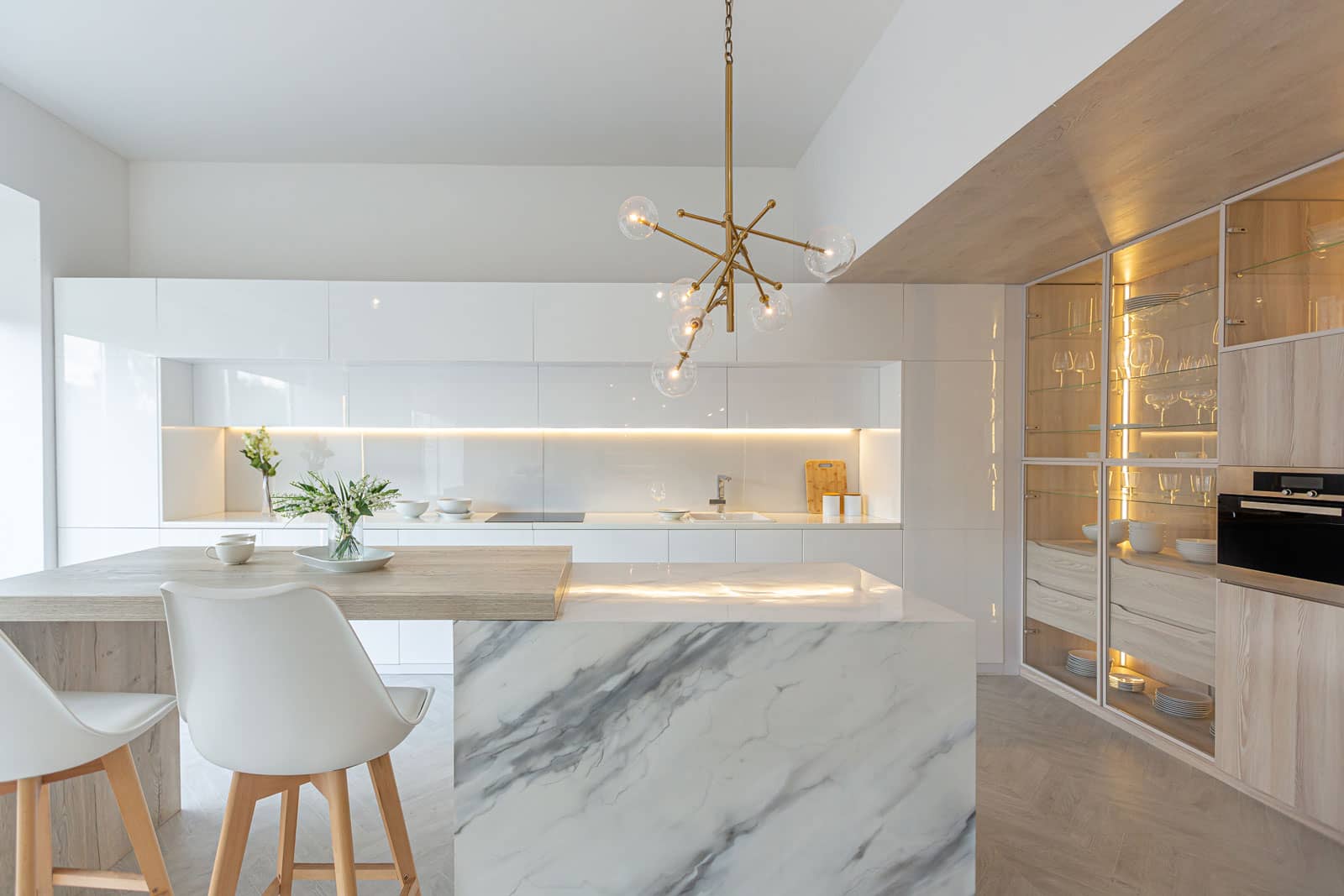
What Are the Most Common Kitchen Island Lighting Mistakes?
- Hanging too high. By far the most common. Homeowners get nervous about headroom and end up at 42 inches, where kitchen island lighting stops feeling connected to the island at all.
- Under-scaling. A 4-inch pendant over a 9-foot island looks like a typo. Kitchen island lighting should be bolder than instinct suggests.
- Mismatched color temperature. 2700K pendants over 4000K cans. Nobody can say why the room feels wrong.
- Skipping the dimmer– or sharing one with everything else.
- Centering on the room instead of the island. If the island isn’t centered in the room, the fixtures still aren’t.
- Buying before measuring. Online kitchen island lighting gets returned constantly because the stem kit won’t reach a vaulted ceiling.
- Ignoring the seated sightline. If guests lean around the pendants to see each other, the fixture failed at its actual job.
How Should Kitchen Island Lighting Work With the Rest of the Kitchen?
Kitchen island lighting is one layer of four. Get the layers right and the pendants can be simple:
- Ambient: recessed cans on the perimeter, 24–30 inches off the wall, dimmed independently
- Task: undercabinet lighting on the run- the layer people skip and the one doing the most work
- Accent: in-cabinet glass lighting, toe-kick, open-shelf strips
- Decorative: your kitchen island lighting, plus sconces or a dining fixture
Kitchen island lighting should be the prettiest layer, not the hardest-working one. When homeowners try to light an entire island with pendants alone, the result is glare- the fixtures have to be far too bright to carry the room by themselves.
One coordination note: if a dining fixture sits in the same sightline as your kitchen island lighting, the two need a relationship. They don’t have to match- they do have to agree on finish family, color temperature, and scale.
Frequently Asked Questions About Kitchen Island Lighting
How far apart should kitchen island lighting pendants be spaced?
Space pendant centers 24 to 30 inches apart, and keep the outermost fixture at least 6 inches- ideally 12- inside the island’s edge. On a 9-foot island with three pendants, we place the outer two about 12–18 inches in from each end and center the third. Always check the layout against stool positions before the electrician sets boxes; kitchen island lighting that lands over a seated guest’s head is a spacing failure no matter what the tape says.
Can you mix kitchen island lighting finishes with your cabinet hardware?
Absolutely- and in transitional kitchens you should. The rule that keeps mixed metals from looking accidental: choose two metals and repeat each at least twice. Aged brass kitchen island lighting works beautifully with polished nickel plumbing, as long as the brass reappears somewhere- sconces, pulls, a pot filler- and the nickel does too. A single unrepeated finish reads like a leftover.
What size pendants should you use for kitchen island lighting?
Divide island length in inches by three to find each pendant’s zone, then choose a fixture roughly 8–14 inches in diameter. A 6-foot island typically takes two 12–16 inch pendants; a 9-foot island takes three 10–14 inch pendants or a 48–60 inch linear fixture. When torn between two sizes, go bigger- under-scaled kitchen island lighting is a far more common regret than over-scaled.
Do you need a permit for kitchen island lighting in Orange County?
Swapping fixtures on existing junction boxes generally doesn’t require one. Adding new boxes, running new circuits, or altering the electrical system typically does- and your kitchen island lighting will need to meet current Title 24 requirements, including high-efficacy sources and compliant controls. Requirements vary by city and permit date, so confirm with your building department in Tustin, Irvine, Newport Beach, or wherever your project sits. A licensed contractor should handle this as part of scope.
What color temperature is best for kitchen island lighting?
2700K for warm, traditional, and coastal kitchens; 3000K for modern kitchens with cool-toned stone or white marble. Avoid 3500K and above in a residential kitchen- it reads clinical and makes food look bad. More important than the exact number: match every bulb in the room and specify CRI 90+ across all your kitchen island lighting. High CRI is the least expensive upgrade available and the one you notice every day.
Ready to Get Your Kitchen Island Lighting Right?
Kitchen island lighting is the detail that separates a kitchen that photographs well from one that lives well. Getting it right means coordinating fixture selection, ceiling structure, electrical rough-in, Title 24 compliance, and finish story- ideally before a single box gets set. That’s the part we do.
Mars Brothers Kitchen & Bath is a family-owned remodeling contractor based in Tustin, serving Irvine, Newport Beach, Dana Point, Laguna Niguel, and the greater Orange County area. We handle kitchen remodels, bathroom renovations, custom closets, and flooring- and we’ve planned kitchen island lighting for everything from 8-foot tract ceilings to two-story coastal vaults.
Bring us your island dimensions and your ceiling height. We’ll tell you exactly what your kitchen island lighting should be- and what it shouldn’t.